Showing posts with label Dhammapada. Show all posts

Tuesday, September 16, 2025

The Path of Non-Violence in Buddhism

In a world often marked by conflict, division, and unrest, the teachings of the Buddha offer a beautiful reminder: true peace arises not from domination or force, but from compassion and non-violence. Ahimsa, or non-violence in Pali is one of the central pillars of Buddhist practice. It is more than the absence of physical harm, it is a way of living that cultivates kindness in thought, word, and action.

Consider how we witness people behaving today. Most are fearful of loss and succumb to greed and stinginess as we see with excessive buying. When people fear loss they tend to be aggressive with what they have. 

But the 'things' people crave is not limited to physical items. It could be status and services too.

The Buddha taught that all beings share the desire to be free from suffering. Recognizing this truth, we are invited to treat others with the same care and respect we wish for ourselves. This insight helps dissolve the illusion of separateness that often fuels hostility. When we see others as interconnected with our own life, harming them becomes unthinkable. 

Practicing non-violence begins within. Our own minds can be battlegrounds filled with anger, resentment, or fear. Buddhist meditation offers tools to soften these tendencies. Through mindfulness, we learn to witness emotions without being controlled by them. Through loving-kindness (metta) practice, we actively cultivate goodwill, even toward those who may have harmed us. These practices transform the roots of violence at their source, the human heart.

Non-violence also extends into daily interactions. It shapes how we speak, ensuring our words heal rather than wound. It influences how we consume, reminding us to live simply so that others may also live. It guides our response to conflict, encouraging patience, listening, and the search for mutual understanding over retaliation.

Living non-violently is not always easy. It requires courage to meet hostility with compassion and strength to resist the pull of anger. Yet each step on this path brings a deeper sense of freedom. As the Dhammapada teaches, “Hatred is never appeased by hatred in this world. By non-hatred alone is hatred appeased.”

In practicing non-violence, we are not only creating peace for ourselves but planting seeds of peace in the world. Every compassionate action, every kind word, and every gentle thought contributes to a more harmonious and awakened society.


Sathu. Sathu. Sathu.


Educate Your Mind With The Dharma.
 
**********************************************************************************************
Vladimir warmly and skillfully passes on the Buddhas Dharma to a world in need of loving-kindness, compassion, and empathy for the benefit of all living beings.
 
To learn more about us and for free mindfulness and mediation resources you are warmly invited to visit: www.bluelotusmeditation.us
 
Looking for a way to help guide others? Become a Blue Lotus Aspirant here: https://bluelotusmeditation.us/continue-your-journey
 
US Tax deductible donations may be offered here: https://www.paypal.com/donate/?hosted_button_id=88BRNH3K7Y7FQ
 
Blue Lotus Meditation and Mindfulness Center is a 501(c)(3) Buddhist society.

Monday, May 23, 2022

The Five Great Dreams of The Bodhisatta

Prior to Buddha becoming the revered one we refer to today like all of us he too was on a journey of discovery. In pursuit of this wholesome knowledge he abandoned all worldly possessions and comforts. Over the course of five or six years he studied under many gurus of the day but either learned nothing new or quickly surpassed their teachings. 

Sidharth Gautama

Not long before his awakening he lived a solitary life which aided immensely to the extra-ordinary progress and strengthening of his mental concentration. 

Living in utter seclusion for fifteen days, the noble Bodhisatta (Sidharth Gautama right before his awakening into Buddhahood), dreamed five Great Dreams after midnight, just approaching dawn on the fourteenth waxing day of the month of Vesākha (the second month of the Buddhist calendar).


The Five Great Dreams and Their Interpretation


 1. When the Tathagata; worthy and rightly self-awakened; was still an un-awakened bodhisatta, this great earth was his great bed. The Himalayas, king of mountains, was his pillow. His left hand rested in the eastern sea, his right hand in the western sea, and both feet in the southern sea. 

Buddhas First Dream
This first great dream appeared to let him know that he would awaken to the unexcelled right self-awakening.

2. A woody vine growing out of his navel stood reaching to the sky. 

This second great dream appeared to let him know that when he had awakened to the noble eightfold path, he would proclaim it well as far as there are human and celestial beings.

Buddhas Dreams

3. White worms with black heads crawling up from his feet covered him as far as his knees. 

This third great dream appeared to let him know that many white-clothed householders would go for life-long refuge to the Tathagata.


4. Four different-colored birds coming from the four directions fell at his feet and turned entirely white. 

This fourth great dream appeared to let him know that people from the four castes: priests, noble-warriors, merchants, and poor, having gone forth from the home life into homelessness in the Dhamma and Vinaya taught by the Tathagata, would realize unexcelled release.


Buddha Meditating
5. In the fifth dream the Tathagata walked back and forth on top of a giant mountain of excrement but was not soiled by the excrement

This fifth great dream appeared to let him know that the Tathagata would receive gifts of robes, alms food, lodgings, and medicinal requisites and that he would utilize them without any attachment and clinging to them.

And it was with these dreams and their interpretation that Sidharth Gautama was then given the Four Noble Truths and the Noble Eightfold Path that was became the Buddha or the Enlightened One we know today. And on this day, which is called Vesak Day, Buddhists all around the world celebrate.  


And with that my friends I wish you all peace and ease,


Vladimir


You are warmly invited to follow on us on Facebook and Instagram @bluelotuscenter for more way to improve your mindfulness practice and wellbeing.

Blue Lotus Meditation and Mindfulness Center is a registered 501(c)(3) religious organization.

Website and monthly newsletter: www.bluelotusmeditation.us

For guided meditations and Dharma talks, please visit and subscribe to our YouTube channel.

Facebook

Instagram

AmazonSmile


Sunday, March 13, 2022

The Three Jewels of Buddhism

In Buddhism there are what as known as ‘The Three Jewels’ and each of these jewels represents a wonderful place of refuge. Remember, as the Buddha revealed to us in the Four Noble Truths, life will constitute moments of suffering or displeasure or unhappiness. And a refuge is a place where way may seek sanctuary or safety during these, and any other moments for that matter, of our lives.

The Three Jewels are: The Buddha, The Dharma, and The Sangha.

But what do they mean? How may we meaningfully incorporate them into our lives?

Let’s first examine what they mean.

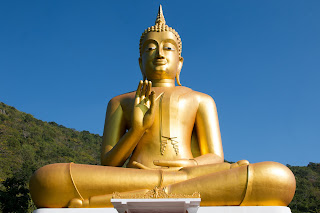
Golden Buddha
The Buddha is simple the historical figure you’re probably already familiar with, much like Jesus in Christianity. However, unlike Jesus, Buddha was a man exactly like you and me. We recognize Buddha as the enlightened one who discovered the path to liberation form cravings and clinging by leaving his princely life to one of self-discovery.

Dharma Wheel

The Dharma
are what we consider the Buddhas teachings. The three main teachings consist of The Four Noble Truths, The Noble Eightfold Path, and the Dhammapada, however there are a number of stories illustrating his wisdom and kindness. When you examine the Dharma you see the common themes of mindfulness, kindness and ethical conduct throughout. The Dharma is often represented by an eight spoked wheel.

Sangha
The Sangha is the spiritual group or community of Buddhists, much like a congregation is to a church. The Sangha is an important part of the spiritual community because it’s where we may learn from others who may be more advanced than we are but also from each other. Some examples of a Sangha are those living the monastic life, laypeople gathering to practice, or even viewers watching a talk on YouTube. The interpretation of a Sangha is all inclusive if you like.

So how do we incorporate the Three Jewels into our daily practice?

For me, I recite the following during my morning meditations.

I take refuge in the Buddha and the Buddha takes refuge in me.

I take refuge in the Dharma and the Dharma takes refuge in me.

I take refuge in the Sangha and the Sangha takes refuge in me.

Notice the second part, the phrase ‘takes refuge in me’. This is an important part of Buddhism; we are not separate from life; we are not separate from each other. This is a concept known as interbeing and as we take refuge in one of the jewels that jewel takes refuge in us.

So we may also think of these recitations as:

As I sit with the Buddha, the Buddha sits with me.

As I sit with the Dharma, the Dharma sits with me.

As I sit with the Sangha, the Sangha sits with me.

To me, this understanding, this connection to all life, is what makes Buddhism special to me. We are not dominate over anyone nor are we subservient to anyone; we are all precious and worthy. And in knowing this how can we be mean or cruel to one another?

With that, I invite you to explore this question more in-depth. I think you’ll find the answers liberating.


I wish you all peace and ease,

Vladimir

The Sixteen Imperfections of the Mind | The Eight Imperfections : Part 2 Subtle Distortions of Identity

As we continue, the first eight imperfections are loud and easy to recognize. The second eight are quieter. They hide behind respectability ...