Showing posts with label four noble truths. Show all posts

Tuesday, May 23, 2023

Purpose And Goals: A Mindful Approach

Purpose and goals. These are two words we frequently hear and often misuse. What is your purpose in life? Where do you see yourself in five years? Let's explore the differences and see if there may be an overlap between the two.

Crossroads

In living, sentient beings, purpose is not function or usefulness. Purpose is simply 'meaning' in the spiritual sense and may only be bestowed on a living, sentient being. A screwdriver cannot have 'purpose' because it is not alive, obviously.

Whereas a goal is a desire that may only be accomplished in the future. Therefor once it’s been achieved it’s no longer a goal. I would like to eat lunch today. I see myself as a business owner. Or I would like to finish college by next year. As you see we may have many goals in life.

Do you need 'purpose' to live a meaningful life? We all would like to think so. We would like to think that our existence will have a positive impact on at least one person. So, the question of ‘do I have purpose’ may weigh heavy on your mind.

So how do we answer this question from a Buddhist and mindfulness perspective? For this discussion we are going to exclude any notion of divinely derived causality for our existence and simply look at what the Buddha taught.

When we look at Buddhas very first teaching he explains the Four Noble Truths: There is suffering in the world, attachment is the cause of suffering, there is a way to end suffering, and that way is the Noble Eightfold Path.

No one wants to suffer and that’s why we have goals. We hope that with a college degree we may get a better job which will ease our suffering. Or maybe we’d like a bigger house in the country away from the hustle and bustle of city life. Or perhaps we'd like to move into the city because country life is too quiet.

But accomplishing any one or more of these goals will not ease your suffering for any meaningful length of time. If you get a bigger home, then you might need to worry about protecting your possessions and get a security system. Certainly this scenario cannot be the purpose of your life, can it? 

Supportive Friends

Let’s circle back to the First Noble Truth, there is suffering in this world. Since we know this to be a factual statement then couldn’t our purpose be to help ease the suffering of others? Rather than focusing on ‘I” or “me’ as we have been taught instead, we shift our perspective to ‘we’ and ‘others’. This paradigm shift is certainly meaningful, for what greater good can there be than helping those that are suffering.

Buddhism isn’t about achieving enlightenment or Nirvana. These outcomes may be the result of the practice and maybe not even in this lifetime. The heart of Buddhism is easing suffering for us and others and the way to accomplish this is through the Noble Eightfold Path. Following this path, even to a small degree, helps you change your outlook to one that is purposeful and meaningful instead of one that is materialistically goal orientated.

Do you need purpose to have a meaningful life? The simple fact is you already do. It’s an innate quality of being born a sentient being and a quality that is often overlooked in our busy and distracted lives.


Wishing you continued peace and wellbeing,


Vladimir


You are warmly invited to follow on us on Facebook and Instagram at @bluelotuscenter for more ways to improve your mindfulness practice and wellbeing.

Blue Lotus Meditation and Mindfulness Center is a registered 501(c)(3) religious organization.

Website and monthly newsletter: www.bluelotusmeditation.us

For guided meditations and Dharma talks, please visit and subscribe to our YouTube channel.

Facebook

Instagram

Wednesday, November 23, 2022

Finding Gratitude In Times Of Hardship

The first Noble Truth of Buddhism easily states that there is suffering in life. Suffering is an inherent component of existence. Therefor we will experience days that are challenging, upsetting, or downright scary to us.

Maybe we miss our bus or train to work.

Traffic Jam

An important relationship of ours ends without warning.


Bad weather cancels an event we have been looking forward to for so long.


Or perhaps we receive the news that a loved one has passed away.


Any one of these situations or a multitude of others may make us feel that our day, our week, or even our lives are over. But these thoughts only reinforce our notion of permanence and clinging to 'way things were'.


However, when we remove these surficial response or our initial reactions of these feelings we begin to realize yes, that experience may not be what we desired or expected but it is here now.


The more we resist the experience the more we will continue to suffer from the experience.


We agree to accept the experience for what it is.


It’s only when we accept an experience that is hard or unexpectedly challenging that we are able to find gratitude in that present moment.


Imagine you come home from work one day and your home is empty.


On the table is a note from your partner saying that they were unhappy and felt it necessary to end this relationship.


Your initial response could be one of fear, or anger, or uncertainty. Who will love me? I’ll never make it without them in my life. I’m sure there are a lot of other things you may say as well in your mind if not aloud.


But notice the focus of these questions and statements: ‘Me’ 


And if we continue with these self-centered thoughts that are no-doubt debilitating and untrue about yourself we will not be able to find the gratitude from that experience.

Selfcentered


That experience taught you some valuable lessons or offered some important experience. 


Maybe you learned how to cook. Or balance a checkbook. Or paint. Or exercise.


If it was an exercise routine maybe you're in better physical condition than before. That's certainly a positive outcome from this relationship.


Another example could be the following.


Maybe your alarm clock malfunctions and you wake up late for work. Not by a little but by a lot. There is no way you’ll get to work at your scheduled time. You call your supervisor with some anxiety and trepidation but calmly let them know you’ll be late.


It turns out that there was a large power outage at 3 AM as a result of a passing storm and you’re not the only one that was affected by this unexpected event.


As you hang up the phone you look out the window and just above the horizon you see the most beautiful sunrise that you’ve seen in such a long time. You realize that this is a sight you haven't seen in a long time because by now you're in the office.


In this example there are at least two opportunities to be grateful for.


One, you were able to experience the beauty of the new day beginning. From the deep purples, to lavenders, to salmon, to a beautiful blue sky.


And two, you have a supervisor that is understanding of others challenging life experiences.


But not every experience is benign as a power outage so how do we find gratitude when a loved one passes? 

Two people supporting each other


The passing of a loved one elicits a much deeper emotional response depending on the level of bonding between two people, but what one may do is not to think of the loss of the person but to be grateful for the experience. 


There are now 8 billion people on Earth and you will only ever encounter a very, very small percentage of its inhabitants. So the fact that the two of you were able to share many times together is a very unique experience shared only between the two of you. And that gift is one that truly never disappears and is something to be grateful for. 


We will all experience times of disappointment, grief, sadness, and hardship. But how long we live in those moments is entirely up to us. And the more we focus on ‘us’ and not the moment we will continue to perpetuate a clouded perspective.


When we learn to respond to a situation rather than react to one we are able to find gratitude in it, no matter how saddening or challenging it is.


And when we learn to respond with openness instead of resistance, curiosity instead of certainty, love instead of fear, we are able to allow ourselves to experience the joy of gratitude.  


Wishing you continued peace and wellbeing,


Vladimir


You are warmly invited to follow on us on Facebook and Instagram @bluelotuscenter for more ways to improve your mindfulness practice and wellbeing.

Blue Lotus Meditation and Mindfulness Center is a registered 501(c)(3) religious organization.

Website and monthly newsletter: www.bluelotusmeditation.us

For guided meditations and Dharma talks, please visit and subscribe to our YouTube channel.

Facebook

Instagram 

AmazonSmile


Monday, May 23, 2022

The Five Great Dreams of The Bodhisatta

Prior to Buddha becoming the revered one we refer to today like all of us he too was on a journey of discovery. In pursuit of this wholesome knowledge he abandoned all worldly possessions and comforts. Over the course of five or six years he studied under many gurus of the day but either learned nothing new or quickly surpassed their teachings. 

Sidharth Gautama

Not long before his awakening he lived a solitary life which aided immensely to the extra-ordinary progress and strengthening of his mental concentration. 

Living in utter seclusion for fifteen days, the noble Bodhisatta (Sidharth Gautama right before his awakening into Buddhahood), dreamed five Great Dreams after midnight, just approaching dawn on the fourteenth waxing day of the month of Vesākha (the second month of the Buddhist calendar).


The Five Great Dreams and Their Interpretation


 1. When the Tathagata; worthy and rightly self-awakened; was still an un-awakened bodhisatta, this great earth was his great bed. The Himalayas, king of mountains, was his pillow. His left hand rested in the eastern sea, his right hand in the western sea, and both feet in the southern sea. 

Buddhas First Dream
This first great dream appeared to let him know that he would awaken to the unexcelled right self-awakening.

2. A woody vine growing out of his navel stood reaching to the sky. 

This second great dream appeared to let him know that when he had awakened to the noble eightfold path, he would proclaim it well as far as there are human and celestial beings.

Buddhas Dreams

3. White worms with black heads crawling up from his feet covered him as far as his knees. 

This third great dream appeared to let him know that many white-clothed householders would go for life-long refuge to the Tathagata.


4. Four different-colored birds coming from the four directions fell at his feet and turned entirely white. 

This fourth great dream appeared to let him know that people from the four castes: priests, noble-warriors, merchants, and poor, having gone forth from the home life into homelessness in the Dhamma and Vinaya taught by the Tathagata, would realize unexcelled release.


Buddha Meditating
5. In the fifth dream the Tathagata walked back and forth on top of a giant mountain of excrement but was not soiled by the excrement

This fifth great dream appeared to let him know that the Tathagata would receive gifts of robes, alms food, lodgings, and medicinal requisites and that he would utilize them without any attachment and clinging to them.

And it was with these dreams and their interpretation that Sidharth Gautama was then given the Four Noble Truths and the Noble Eightfold Path that was became the Buddha or the Enlightened One we know today. And on this day, which is called Vesak Day, Buddhists all around the world celebrate.  


And with that my friends I wish you all peace and ease,


Vladimir


You are warmly invited to follow on us on Facebook and Instagram @bluelotuscenter for more way to improve your mindfulness practice and wellbeing.

Blue Lotus Meditation and Mindfulness Center is a registered 501(c)(3) religious organization.

Website and monthly newsletter: www.bluelotusmeditation.us

For guided meditations and Dharma talks, please visit and subscribe to our YouTube channel.

Facebook

Instagram

AmazonSmile


Sunday, March 13, 2022

The Three Jewels of Buddhism

In Buddhism there are what as known as ‘The Three Jewels’ and each of these jewels represents a wonderful place of refuge. Remember, as the Buddha revealed to us in the Four Noble Truths, life will constitute moments of suffering or displeasure or unhappiness. And a refuge is a place where way may seek sanctuary or safety during these, and any other moments for that matter, of our lives.

The Three Jewels are: The Buddha, The Dharma, and The Sangha.

But what do they mean? How may we meaningfully incorporate them into our lives?

Let’s first examine what they mean.

Golden Buddha
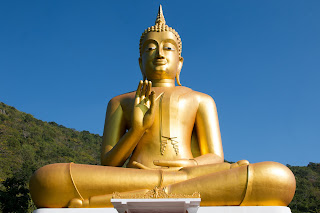
The Buddha is simple the historical figure you’re probably already familiar with, much like Jesus in Christianity. However, unlike Jesus, Buddha was a man exactly like you and me. We recognize Buddha as the enlightened one who discovered the path to liberation form cravings and clinging by leaving his princely life to one of self-discovery.

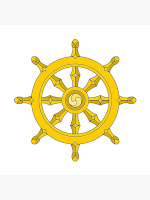
Dharma Wheel

The Dharma
are what we consider the Buddhas teachings. The three main teachings consist of The Four Noble Truths, The Noble Eightfold Path, and the Dhammapada, however there are a number of stories illustrating his wisdom and kindness. When you examine the Dharma you see the common themes of mindfulness, kindness and ethical conduct throughout. The Dharma is often represented by an eight spoked wheel.

Sangha
The Sangha is the spiritual group or community of Buddhists, much like a congregation is to a church. The Sangha is an important part of the spiritual community because it’s where we may learn from others who may be more advanced than we are but also from each other. Some examples of a Sangha are those living the monastic life, laypeople gathering to practice, or even viewers watching a talk on YouTube. The interpretation of a Sangha is all inclusive if you like.

So how do we incorporate the Three Jewels into our daily practice?

For me, I recite the following during my morning meditations.

I take refuge in the Buddha and the Buddha takes refuge in me.

I take refuge in the Dharma and the Dharma takes refuge in me.

I take refuge in the Sangha and the Sangha takes refuge in me.

Notice the second part, the phrase ‘takes refuge in me’. This is an important part of Buddhism; we are not separate from life; we are not separate from each other. This is a concept known as interbeing and as we take refuge in one of the jewels that jewel takes refuge in us.

So we may also think of these recitations as:

As I sit with the Buddha, the Buddha sits with me.

As I sit with the Dharma, the Dharma sits with me.

As I sit with the Sangha, the Sangha sits with me.

To me, this understanding, this connection to all life, is what makes Buddhism special to me. We are not dominate over anyone nor are we subservient to anyone; we are all precious and worthy. And in knowing this how can we be mean or cruel to one another?

With that, I invite you to explore this question more in-depth. I think you’ll find the answers liberating.


I wish you all peace and ease,

Vladimir

Thursday, September 23, 2021

How Mindfulness Literally Saved A Life

The Power Of Doing Nothing

We all have read a poem or story or heard a speech that moved us in some way. Sometimes these words are so moving and life altering that they help us to adjust course along our life's path.

We often do not understand the power of our words. Some people do and use this realization for either personal gain or for the benefit of others. It is also important to realize that you do not need to be in a position of power to have this effect on people too. It could be a small post on social media, a kind word to a stranger passing by, that impacts a persons life.

To my knowledge I have never been that person who had positively impacted another's life in such a way. It was not until the other day when I had a very humbling conversation with one of my practitioners who passed on a conversation they had had with another fellow practitioner.

It was related to me that this person had accidently stumbled on our Sangha and thought what the heck, I'll give mindfulness meditation a try.

woman overwhelmed

It turns out this fortunate encounter saved their life, literally. There was a lot going on in this persons life and they were at an impasse. But the practice of sitting and 'doing nothing', connecting with themselves and the world around them, and relearning all that they had been taught in the past changed their perspective for the better.

Mindfulness allowed them to change their perspective from one that had a catastrophic outcome to one that was more subdued and then eventually to one of balance. Perspective is an important consideration when analyzing a situation. Most often we view circumstances in the most catastrophic manner possible. And more realistically it is not typically a viable outcome.

People often tend to dwell on a situation, playing it forwards and backwards, constructing 'what if's' that too will never come to fruition all in the name of 'covering their bases'. When we look back at many of these events in our own lives we see that they very seldom happen and if they do it is no where near as bad as we play in our minds.

All in all, you are still here and you have overcome what ever the circumstance was.

The situation they were currently dealing with did not change. However their perspective, or view, as a direct result of sitting mindfully, connecting with themselves to achieve calmness of this circumstance did. And that is one of the many results of mindfulness.

support, holding hands

One person can make a difference and that person can easily be you. Everyone you meet, even for the briefest of moments, whether it is at the grocery store, the cashier at a restaurant, the cart collector at a retail store, is an opportunity for you to help someone.

Many people are fighting internal battles which we will never know and part of being a mindfulness practitioner is helping people ease their suffering.

Be kind. Be considerate. Be empathetic. You never know what someone else is going through.


I wish you all peace and ease.


Vladimir


Blue Lotus Mindfulness and Meditation Center is a registered 501(c)(3) religious organization.

Sunday, August 1, 2021

Right Thought And Thinking Traps

Fostering Right Thought For Wellbeing

Why do we oftentimes support others more than we do ourselves? Do we feel others are more capable than we are?

Recall the Noble Eightfold path – Right Thought. Wholesome thoughts that serve to uplift us. Now, that doesn’t mean not to evaluate with honest reflections on mistakes, that’s how we learn. 

But Right Thought can mean we search with sincerity so we can improve ourselves, not belittle ourselves.

So what are thinking traps? Thinking traps are ways we process , rationalize, or justify actions or results thereby holding us back from being truly connected with ourselves and our surroundings. They are traps that do not promote nor foster Right Thought.

I’ve selected five that I feel are most common although there are a few more to consider.

i. Mind Reading

This is a common trap that a lot of people do and it is still very detrimental. Mind reading is when we assume we know what others are thinking or what they think of us. 

Two women looking
We may misinterpret an innocuous look or gesture and have mentally determined an outcome.

Try to recall a situation in your life when you had a preconceived notion of an outcome (positive or negative) and the person did the opposite.

For example, as you sit with friends as a restaurant you 'just know' that this attractive person is looking at you intently but you soon realize you're sitting under the TV.

ii. Fortune Telling

Although similar to mind reading this is more situational mind trap. Here, we've already determined the outcome of a particular situation.

tarot cards
It doesnt necessarily have to be what we would consider a negative outcome and could easily be a positive result as well. 

For example, I just know I'm not going to get that promotion so I wont even try. Or, this teacher is so easy I wont study for their exam.

Or another example, you 'just know' that Tabitha will forget to bring a side dish to our company picnic. But as you approach the table, she's unwrapping her dish.

Both of these examples result in an outcome opposite of what you had 'predicted'.

iii. Black/White Or Binary Thinking

This thinking trap is dangerous on several levels. For one, it doesn't allow you to accept a middle ground. Very few events in life are binary. But the dangerous aspect comes from others and 
ay also be a sign of a manipulative and controlling person.
Black and White

When one is only able to consider such binary outcomes from a situation one is minimizing another persons perspective of the situation, particularly intention. 

For example, if someone offers you assistance in a task they are not very proficient with and as a result does not perform it well the black and white thinker would be quick to point out the faults instead of the loving, supportive effort offered.

iv. Fallacy Of Fairness

You think you know what is right or fair. If someone gets something you feel you're entitled to as well or they're not deserving of you may feel that the world is out to get you. 

Balance, scale
Going through life judging what is fair and what is not, one may become angry, resentful, unhappy to the beauty that surrounds you.

For example, currently the US Government is considering some form of student loan forgiveness. There are some individuals who have successfully paid off this debt and feel that others being relieved of all or some portion is unfair.

In ones lifetime, there will always be some person or group of people who receive a benefit that you may not have. Certainly there have been times when you were the beneficiary and others were not.

When we are happy for someone else that elicits compassion for others as well as yourself.

v. Always Being Right

You or others may go to great lengths to prove yourself right and someone else is wrong. Being right was more important than being kind.

Two women arguing
This is very often seen in social media posts where two people, most likely unknown to one another, disagree on a result or comment and one goes on a search to find some small piece of evidence to support his claim.

This is a misuse of your time and energy.


Protecting ourselves from harm, physically and mentally, is an evolutionary self-preservation product but we have also been conditioned by society to be negative. Too much positivity, empathy, and compassion and you are labeled 'soft'. As a result our mind tells us to 'hold back' resulting in limited growth and imbalance.

Developing Right Thought, cultivating what is wholesome and good mentally, is necessary to avoid Thinking Traps. Once we are able to recognize these traps we are able to flourish and embrace the positive life we are capable of having.


Wishing you peace and ease,

Vladimir


Blue Lotus Mindfulness and Meditation Center is a registered 501(c)(3) religious organization.

The Sixteen Imperfections of the Mind | The Eight Imperfections : Part 2 Subtle Distortions of Identity

As we continue, the first eight imperfections are loud and easy to recognize. The second eight are quieter. They hide behind respectability ...