Showing posts with label Teens. Show all posts

Friday, June 23, 2023

Exploring Mindfulness For Teens

Being a teen in this day and age is much different than when your parents were your age. I'm sure you've heard this before. This same sentiment was certainly felt when your grandparents talked to your parents as well about most of the same concerns. If you choose to have children, these same feelings and sentiments will be expressed to them. It's a normal cycle from parent to child. 

Teens
But for now, let's explore mindfulness today and how it will benefit your current as well as your future wellbeing. Your thoughts and concerns about so many changes and new experiences may all seem overwhelming. So as you read this know that this time, right now is all about you, your relationship with your parents, teachers, friends, the future, and the most important relationship you’ll ever have: with yourself.

So many aspects of your life are at a point where they may feel like they just want to burst out. This is normal. Our bodies experience many different sensations that are a result of our brains releasing different hormones into our system. This may, at times even manifest itself in an uncomfortable physical sensation. 

Sometimes, depending on the intensity of the sensation our mind may construct some type of story which oftentimes isn't true. We may feel overly sensitive to some from of rejection when there was no intended malice. Before we respond, we need to mindfully examine the situation for what is is and not what we 'think' it is. 

So when we experience these uncomfortable sensations it is important to recognize these conditions in the moment so we may bring mindful awareness to them. Remember, being mindful is also being non-judgmental towards having those feelings.

Teen, Parent

As a teen I'm sure you have many different types of relationships, but how do you walk a wholesome path with your relationships? 

How do your peers feel? Your peers have the exact questions as you and are experiencing the same feelings of uncertainty you are, although they may express it differently.

Some common questions you may have are:

    - Do my friends like me? Sure, they're your friends!

    - What will I do after high school? Does it truly matter? I promise you it doesn't but what does matter is how kind you are. That's what people will remember.

    - Are you the class clown? This 'hey, look at me' suggests that one is desiring affirmation or some form of positive reinforcement from a bad behavior. A sarcastic remark perhaps?

    - Social media presence. Keep it 'G - Rated'. There was an old saying during World War II that went 'loose lips, sink ships'. You don't want that sinking ship to be yours next week, next year, or five-years from know. Besides, you shouldn't be doing hurtful things anyway, right?

    - Parents. Yes, they love you and yes, they're proud of you. Sometimes parents get mad at you because of 'their' expectations for you. It's an extension of their world view that doesn't necessarily align with yours. Be cool about it and simply bring awareness to the fact that they don't want to see you hurt.

    -Teachers. This is a hard job, no question about it. Imagine you coming into work each day and seeing probably over 100 different people each with their own unique personality and needs going through life changes. Not to mention teachers are people too that are also dealing with sometimes stressful life events. Be empathetic and compassion towards them. 'After' you graduate recall a few of the good ones and friend them on Facebook (old people don't use Snapchat) and keep in contact with them. Knowing they made a positive difference in a students life is truly why they're in the profession.

    - Yourself. You will always have you. The face in the mirror will change as you get older but your essences will always be 'you'. Long after your body has ceased to exist, your conscience will always be there. Do good and engage in kind actions in this life so that you have a better future in this life and the next.

As you begin to experience more situations it’s important to start now to develop the necessary skills to mindfully address not only adversity and disappointment but overwhelming joy and good times as well. Both circumstances can lead to additional suffering if not viewed appropriately.

How can too much joy cause suffering?

When either side of our emotional state is out of balance suffering occurs but when we are too overjoyed for too log we develop an emboldened ego. This leads to feelings of superiority which may lead to risk taking behavior.

You will make mistakes along the way, we all do, including adults, and the mistakes we make aren’t the problem. It’s living in them long after they have occurred. Learning to let go of guilt and shame are liberating and allow you to experience life in a more wholesome way. Learning to let go also holds true to those who may have hurt you.

So how can you, as a teen, begin mindfulness practice?

Meditation is certainly involved in the process but even before you begin this truly search your feelings before you speak or engage in an action. Ask yourself, is it wholesome?

Be certain to help others. Look at service activities at your school (homeless, food pantry, relief funds). Being of service to others develops empathy and compassion and lets go of greed and callousness.

Do your best to try and not wish away your life. Statements like 'I can’t wait until I get my drivers license, or go off to college' take you out of the present moment. Being mindful is about being in the present moment, not the future nor the past.

Apologize first, no matter what the offense. This offers grace and compassion to both of you.

Use kind speech and don’t be sarcastic. The humor wears out quickly and is unappealing even when people laugh.

And last but not least, join our teen sangha - it’s free Wednesdays at 3:30 PM CST. It's important to have a mindful community to help you along.


Wishing you continued peace and wellbeing,


Vladimir


You are warmly invited to follow on us on Facebook and Instagram at @bluelotuscenter for more ways to improve your mindfulness practice and wellbeing.

Blue Lotus Meditation and Mindfulness Center is a registered 501(c)(3) religious organization.

Website and monthly newsletter: www.bluelotusmeditation.us

For guided meditations and Dharma talks, please visit and subscribe to our YouTube channel.

Facebook

Instagram


Friday, March 3, 2023

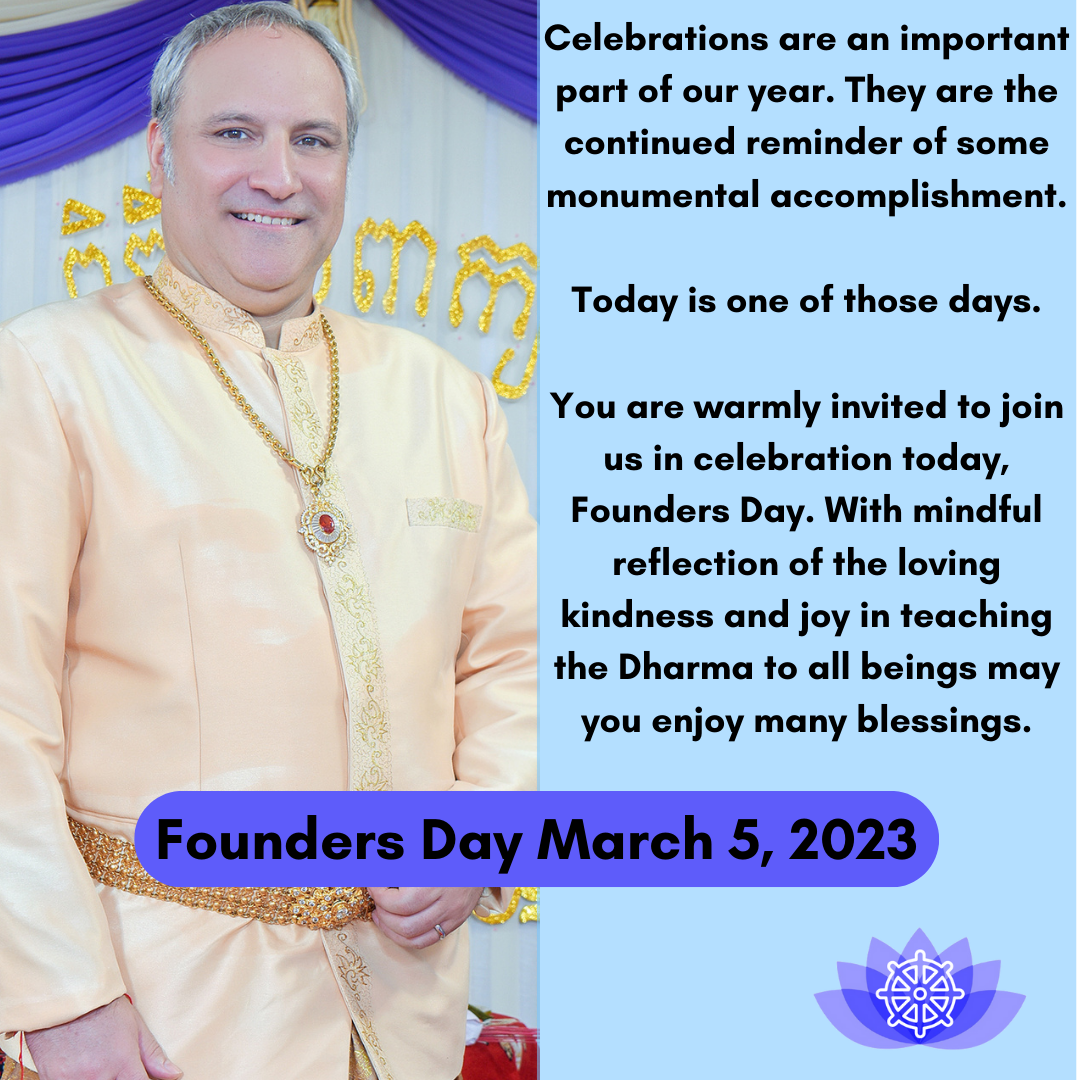
Founders Day Message 2023

Founders Day Message 2023

Celebrations are an important event in that they offer mindful recognition for a meaningful event or an important mile stone. 

Founders Day is a day where I renew my commitment to serving you and to those suffering. It is also a time of mindful reflection on all of the good Blue Lotus Meditation and Mindfulness Center has provided individuals, our community, and the world. Although our practitioners come from all over the world, varying occupations and ages, they all experience suffering. Through Buddhas teachings, we have helped ease the suffering of people coping with addiction, trauma, homelessness, anxiety, stress, relationships, and PTSD to name only a few. 

Our Founder
The work and support we offer is important and meaningful. 

And, most importantly, there is never a fee for any of our offerings.

How we serve others.

Each week we offer virtual sangha's for those that may have experienced trauma, LGBQT+ community, veterans, teens, and a general 'welcoming' sangha. All meetings are conducted via Skype and anonymity, if desired, is always maintained. 

We also offer several developmental classes, Resiliency+, for example. Being resilient is important to survival however when one only survives one misses the true beauty that is around us, even during those hard times.

Our Sutra Study is a weekly meeting where were explore one of the 84,000 Buddhist sutras, their meaning, and how they provide a necessary vehicle for beings to walk a noble path towards enlightenment.

In the summer we also offer a Teen Mindfulness camp. For one week teens from all communities are welcome to camp in our 'outdoor' meditation hall to disconnect from the harmful distractions of life so that they may learn the necessary mindfulness skills to help them navigate the challenges they will face in their adult life. 

Also on the last day of each month from May to September we offer Silent Retreats. Here practitioners from all ages and skill levels are invited to sit in silent contemplation, disconnect from their hectic lives so that they may reconnect to their being. A free vegetarian lunch is served as well. 

How are we able to provide our services at no cost?

Imagine a child or elderly person falling to the ground and in pain. Would you say 'I'll pick you up off the ground but only if you pay me'?

Of course not. You would assist them up, ask if they were OK, and comfort them as needed. 

We are compassionate towards all beings. We have empathy towards all beings. We know that all beings are suffering and we have the means to offer some relief of their suffering. So we do.

We are entirely donation based and warmly welcome all forms of generosity.

Our message?

Simply put, our message, my message, is the same as the Buddhas. It is one of hope. It is one of compassion. It is one of love for all living beings, including yourself.

Birthday Cake
So as you move about your day look at the stranger with welcoming eyes and a warm smile.

Make a donation to a local charity or animal shelter. 

Perhaps even embracing 'noble silence' when a stressful situation arises.

Being kind to those that need it is a wonderful way to share in the joy of this Founders day. 
   

Wishing you continued peace and wellbeing,


Vladimir


You are warmly invited to follow on us on Facebook and Instagram at @bluelotuscenter for more ways to improve your mindfulness practice and wellbeing.

Blue Lotus Meditation and Mindfulness Center is a registered 501(c)(3) religious organization.

Website and monthly newsletter: www.bluelotusmeditation.us

For guided meditations and Dharma talks, please visit and subscribe to our YouTube channel.
Facebook

Instagram


Thursday, December 23, 2021

Mindfulness, Schools, and Our Children’s Mental Wellbeing

Incorporating A Safe Space For Our Children

There was a TicTok video circulating recently calling for violence in our schools across our society. Although law enforcement determined this to be a non-credible threat many parents chose to keep their children home. Some schools even closed. My daughter text me to come pick her up early due to her not feeling safe in her school, regardless of the additional police presence.
Child, school

This text message and ensuing conversation with her caused me to pause and reflect not only on this type of situation that has become an all-too-common occurrence but to many other forms of anxiety and fear within our school system. 

Setting these types of gross violent incidents aside for a moment, consider how often our children experience bullying, ridicule, and instances of ostracizing on a daily basis.

These non-newsworthy actions result in feelings of anxiety and fear in a child in a place that is designed to enrich our young peoples lives.

When we think about our children being bullied we often neglect the ‘bully’ themselves. But they too are victims of fear, violence, ridicule, and anxiety, more likely as a result of some form of trauma at home. 
Child, domestic violence

So here too, a child’s home, is a place that is supposed to be supportive, comforting, and safe for a them but yet it isn’t.

So where is a young person, a child, supposed to feel safe during their day if needed?

Think about a location where you would want to retreat to in these circumstances and what you find comforting, relaxing, non-judgmental, and safe.

During my reflection a thought entered my mind. A room with no tables, no chairs, no aromas, but only soft, clean, and inviting cushions to sit on, and low, and soft, ambient lighting. A room of tranquility.
pretty room, relaxing room

Notice I make no mention of sounds or aromas. This is deliberate because sounds and aromas may trigger the memory of trauma which is what we’re trying to avoid in this room.

Imagine if this type of room were readily available at all times during the school day. Who could potentially use this type of safe space?

I’m sure we can picture a child who is bullied in this room but what about the ‘popular’ girl or boy who is being sexually molested that we have no idea about. Or perhaps it’s the child who is unassuming, who avoids attention because they don’t cause trouble but yet they feel alone inside with screams of pain well hidden from all.

People need a retreat, a safe space, somewhere to regain their balance. A room of tranquility has the potential to offer this to some child in need.

A room of tranquility doesn’t need to be staffed with a mental health professional. It could be staffed with a teacher, an administrator, a priest, a rabbi, a volunteer senior citizen. The only requirement needed is non-judgmental listening if needed and no offerings of advice or suggestions.

Maybe this is the room where a student realizes that their life has value. Maybe this is the room where a student reaches out to a trusted adult to let them know what is happening at home. Maybe this is the room where a student realizes that committing an act of violence in their school will only cause more suffering.

Something to consider, don’t you think?
 

I wish you peace and ease,

Vladimir


Blue Lotus Meditation and Mindfulness Center is a registered 501(c)(3) religious organization.

Saturday, October 23, 2021

Shedding Our Shame

Letting Go Of Our Own Controlling Mindset

What is shame?


Before we get into that we need to understand ego.


Ego is the sense of who we are or at least who we ‘think’ we are. For example, we may identify as male or female, Christian, Jewish, Buddhist, conservative, liberal, American, Dominican, French, white, black, Asian the list is endless.


But are you? Is that what ‘you’ are? 


We are no more any one or several of these self-identifiers or emotions than you are entirely any one emotion: happy, sad, angry, jealous, or disgusted or pleased. These qualities are simply attributes we assign to what we see in a mirror.


Consider the chair you’re sitting in. Together it is a chair but if you break it down it consists of 4 legs, a seat, and a back-rest. 


chair
Remove any one of these items and it’s no longer a chair and it doesn't exist. Even though those parts exist they are not a chair.

Ego is a culmination of many qualities, so in essence ego, therefore, the self is non-existent.


We perceive ourselves as fixed or unchanging. Or, in other words we hold onto ego to define ‘us’ and subsequently remain attached to our definition of ‘us’.


Shame supports attachment and the egocentric view we hold about ourselves. 


Now that we have a general or basic idea of ego and ‘us’ let's consider what shame is not and what it is.


Shame is not remorse nor is it guilt. Remorse or guilt means we are sorry for our actions. ‘I’m sorry I overslept and missed your call.’ ‘I’m sorry I hurt your feelings.” 


Shame, Shaming
Shame says ‘I’m not good enough, or I’m unworthy, or something is inherently wrong with me, or I am flawed’.

You are not flawed in your being. You may make mistakes in judgment at times.


If we were to manifest shame as a person they would be considered an abusive person. Someone we would not want to be in a relationship with.


But often in abusive relationships we justify them and remain out of fear. 


In Buddhism there are two words used to consider what we call ‘shame’ in English.


Hri and Apatrapya.


Hri means to refrain from unwholesome actions due to one's own conscience (self-respect).


And apatrapya means to refrain from unwholesome actions to avoid being reproached by others.


Neither one of these definitions relate to the self destructive feelings or views most of us have been taught to associate with ‘shame’.


We can learn to shed our shame.


Instead of being fearful of not being good enough, or unworthy, or that there’s something wrong with you let’s instead invite compassion in.


Compassion is warm, forgiving, and embracing. It allows us to acknowledge what we are feeling without judgment and to explore why we may be feeling these emotions.


Let me offer an example, at one time or another you’ve probably witnessed a parent with a crying or screaming child. Among the many sayings some parents use is the phrase ‘you should be ashamed of yourself for acting this way in public’. 


woman shaming
This is supposed to quiet the child into submission. Children don't necessarily know the meaning of shame but do know the tone, usually condescending, of their parents' voice and that their behavior was bad. 


Maybe they quiet down. Maybe not.


But what seeds are watered in this circumstance?


One of fear and one of poor self-esteem. That the way they behaved, although undesirable, tells the child that there is something wrong with ‘them’ on the inside. And this is not true.


Again, if this were an adult relationship we could consider this emotional abuse.


Another example could be: an adult returning back to school after several decades. Maybe they don’t have a strong support system at home. It’s been a long time since they’ve had to study like back in high school. Maybe they’re uncertain about ‘how to’ study but they still put forth their best effort. 


They take the test and don’t pass. Thoughts of unworthiness and that they’re not good enough begin to form inside their head. And because of an unsupportive family system they don't want to mention to their spouse or children how they fared. They feel shame. They did their best with the tools they had available. There is nothing ‘flawed’ with their being.


So what are some ways we can invite the warmth of compassion into this situation?


When we invite compassion into our being we understand that we are learning or relearning something. We wouldn’t be harsh to an infant learning to walk. At the slightest teeter we’re there with open arms and a warm smile as they develop balance, confidence, and trust. 


The same holds true for ourselves. When we teeter we can be there with open arms and a warm smile as we develop a skill that may be unfamiliar with. We are not flawed nor unworthy, we are learning. We have become attached to the negative thoughts of ‘us’.


You can shed your shame because you are pursuing a noble path.


But what about if you’re a crime victim? This wasn’t a test you were studying for. Here, there was no way any of your actions influenced an outcome. This was an action well beyond your control and perpetrated by someone else. So why feel shame?


Shame here originates from the feeling of something taken away, an attachment, from you without your consent. It’s a violation. Maybe you felt you should have been more prepared. Maybe you feel you shouldn’t have been in that area...maybe this, maybe that, maybe a million different maybes’. Again here, we have become attached to the negative thoughts that protect our view of ‘us’.


So how do we offer compassion towards ourselves in these situations?


The same way as we mentioned earlier. We accept the experience happened but that it can no longer hurt us. Just like when a child falls, the fall is over.


We open our hearts to ourselves this time. Yes, this terrible thing happened to me. I am in a place of safety now. I did nothing wrong. I am not flawed. 


I am not broken. I am deserving of love. I am deserving of joy. I am deserving of wellbeing.


Instead of the negative self-destructing seeds that do not promote well being, these statements of affirmation are the seeds we can choose to water instead.


I am not broken. I am deserving of love. I am deserving of joy. I am deserving of wellbeing.


I hope this helps you move forward with the beautiful life you are given to enjoy. If you need any additional resources, please feel free to reach out to me.


I wish you peace and ease.


Vladimir


Blue Lotus Meditation and Mindfulness Center is a registered 501(c)(3) religious organization.

Wednesday, October 13, 2021

The Thirty-Three Year Old Grudge

Holding On To The Past To Inhibit Love

Imagine being angry all of the time. What damage must that do to your spirit over the course of an hour? A day? A week? Or, 30 years?

We have often heard that holding onto anger and resentment is like travelling with excess baggage at the airport terminal. It is cumbersome to move around, we bump into people along the way, and we may not get to our gate on-time. It certainly makes for an unpleasant experience moving from one location to another.

train station

Now, imagine holding onto a grudge because of something that happened, not necessarily to you, but within a family. Divorce.

Children and young teens often lack the emotional maturity to realize that whatever is happening between the parents has nothing to do with them. 

Lacking the necessary coping skills, young people often express themselves through unhealthy ways. Violence, sexual activity, stealing, thrill-seeking, drugs, or alcohol may be among these expressions.

All of these actions, and many more, are examples of suffering. 

And as a result, sadly, this all too often extends suffering towards other family members and friends as well. 

In other terms, suffering is labeled as a traumatic experience. And it’s important to remember that trauma is defined by the survivor not necessarily by a specific circumstance.

Sometimes as children mature they 'grow' out of this self-destructive behavior. They've learned to accept the circumstance and to let go of the past so that they may move forward and blossom. 

Sometimes they do not.

It's commonly believed that people need to 'integrate' their trauma to overcome or deal with the experience but that's not true. The traumatic event has already happened. It no longer exists, the danger has passed, but remains in the memory. 

It's commonly believed that people need to 'integrate' their trauma to overcome or deal with it but that's not true. The traumatic event has already happened. It no longer exists, the danger has passed, but remains in the memory. 

The next step, which can be difficult, is accepting that what has happened did happen, and realize it is in the past which can no longer affect us. Acceptance is then followed by letting go, which too can be difficult as well. 

Acceptance and letting go can be successfully accomplished with mindful meditation.   

Imagine a couple divorcing over 30 years ago and one child, now in their upper 40s, still using that experience as justification for their current behavior. 

'I act the way I do in 2021 because of what happened in 1988'

Knowingly causing harm to themselves and others but not seeking the help necessary to stop the suffering that they continuously experience has persisted for decades.

This traumatic event, for this poor child, has been watered and nurtured into resentment and has now manifested as a long-term grudge. 

Long-term happiness, balance, and joy have been replaced with superficial, short-term relationships, low self-esteem, negative police interactions, and perpetual suffering.

woman with luggage

This is not a wholesome and balanced lifestyle especially when so much more is out there and readily available.

Sadly, this has been a long, lonely time to carry this baggage in a terminal to not arrive at a peaceful destination. 

So how may mindfulness help relieve this suffering?

When we sit mindfully breathing in, we can say ‘As I breath in I feel my suffering’. ‘As I breath out I walk forward with peace’

The in breath acknowledges and accepts the suffering they are experiencing while the exhale allows this suffering to pass and they may walk forward without continued suffering.

If you know of someone who has experienced a traumatic event let them know that help is available.


I wish you peace and ease,

Vladimir


Blue Lotus Mindfulness and Meditation Center is a registered 501(c)(3) religious organization.

The Sixteen Imperfections of the Mind | The Eight Imperfections : Part 2 Subtle Distortions of Identity

As we continue, the first eight imperfections are loud and easy to recognize. The second eight are quieter. They hide behind respectability ...