Showing posts with label Religion. Show all posts

Sunday, July 3, 2022

Calming The Mind During Times Of Anxiety

There seems to be always something occurring either in the world or our personal lives that we allow to agitate our minds. Perhaps we wake up only to find an expectation of ours has been altered, not met, or even abandoned. Regardless of the specific situation or circumstance our expectation lies from wanting to control the future, something we know is not possible. Remember, the future does not exist and therefor we cannot control what does not exist. And this may result in the mind becoming agitated or filled with anxiety.

But we do exist, you and I, in this very moment, are in existence. The future, we'll it does not exist, and most likely the future you're envisioning will not manifest itself as badly as you imagine. 

Driving, Rain
When our mind is agitated or unsettled we are not able to think or rationalize clearly. It's as if we are looking at life while driving through a heavy rainstorm uncertain if we're even in our lane. If you've ever been caught in one of these events you know how dangerous it can be. Driving at a high rate of speed, fear of hydroplaning, wipers on high, and windows up and air conditioning on to keep the windows from fogging up. Anxiety increases.

Doing all of these actions won't stop the rain or necessarily increase visibility nor offer much safety. So what is the safest 'action' we can do in times like these? We pull over and wait for the rain to stop or let up so we may safely resume our journey.

In our daily life when our mind becomes agitated, for what ever reason, or decision making or kind thinking becomes unclear so the best we can do is to non-do. We 'pull over' and let the storm of agitation pass.

So how do we 'pull over'? 

First we need to recognize we're even in a storm. We often know this because we get tense, loud perhaps, and angry within. When we recognize our agitation it is only then that we may begin the process of pulling over.

Stepping away from the situation or environment is an important non-doing we may take. Stepping away doesn't mean we are avoiding the situation. It means we recognize that we need some time to reflect and to let calmness in so our agitated mind may begin to settle. This non-doing is a sign of wisdom and compassion for our selves and for others.

From there we may find a location that is enveloped by solitude: a park, a lake, a parked car, or even a library. From there we may begin a more balanced mindful breathing and nurturing meditation. Allowing the mind to settle, allowing the mud to settle, allows for clear and balanced and kind thoughts. At first it may be hard, all types of scenarios surface in our mental playground but given non-doing they to move off and clarity begins to appear. 


Give yourself the time to love yourself. Allowing space and openness within cultivates calmness of the mind. And when calmness blossoms life is witnessed with beauty and joyful fulfillment.  


And with that my friends I wish you all peace and ease,


Vladimir


You are warmly invited to follow on us on Facebook and Instagram @bluelotuscenter for more way to improve your mindfulness practice and wellbeing.

Blue Lotus Meditation and Mindfulness Center is a registered 501(c)(3) religious organization.

Website and monthly newsletter: www.bluelotusmeditation.us

For guided meditations and Dharma talks, please visit and subscribe to our YouTube channel.

Facebook

Instagram 

AmazonSmile

Saturday, April 23, 2022

An Interfaith Memorial Service - A Mindful Perspective

Death happens to us all. For some, life will be long and last many decades or perhaps all the way to the century point. Others, death may come much, much, sooner. Some may experience a violent death. Some may succumb to disease or illness, while most simply die in their sleep peacefully.

There is no escaping this natural process. We all are born. Live for a certain amount of time. And then we pass on to the next state.

And when this passing occurs, shortly thereafter family, friends, and loved ones gather to remember and honor this person. This loving occasion, in one form or another, is common to all religions and people of the world. 

Buddha

One of my revered and sacred duties is to help honor and remember those who has passed in the Buddhist tradition. And over this past weekend my services were required.

I was approached by this loving family about a month ago and they asked if I was able to provide this type of service for their beloved family member. I replied in the affirmative and we began to work out the details since they were all coming from out of town.

There are many ways and traditions that may be followed depending on tone one would like to set but generally they range from traditional services to informal to somewhere in-between. However, they all encompass some traditional aspects such as paying reverence to the Buddha, sutras, and to referring to the person who has passed. In most traditions we refer to the one who has passed as still with us and addressing them by name.

Coming from a predominantly Christian family, the family members I had the pleasure to present to were kind and welcoming but a little unsure of what to expect. Afterall this was, I assume, the first time they had ever experienced any type of religious service other than a Christian one.

Candle, Candle light

An alter was already set up with some wonderful pictures of the deceased that spanned throughout their life, there was a beautiful flower arraignment, as well as their ashes. I added some candles and invited others to light an incense stick if they wanted.

As I began, I warmly welcomed them and thanked them for coming to this service. I set the tone as one of light and informal, yet a supportive, gathering of friends. This matched the deceased persons personality.

When speaking to any audience it’s important to make some type of connection. Here I chose to highlight the similarities between the two types of services. In Buddhist services we offer homage to the Buddha. I let them know that Buddhist don’t regard him as a ‘God’ but we are acknowledging his achievements, much like a Christian might prey to St. Christopher before a journey or a high school student would to St. Mary before a math test.

Where something new or unfamiliar occurred, I explained the significance. This is how you build an understanding and promote growth.

After this was the eulogy which was then followed by an opportunity for family and friends to share their stories and fond memories of the deceased. As with most public speaking it’s hard to get the first one going but when it happens stories flow like a waterfall. It truly is an amazing time for all. 

Flowers, Bouquet

We talked about the many gifts this person gave to those around her, from people needing guidance, to appliances, or just a warm hug. This person was always there to help support. And I gently let the audience know that this gathering too was a gift.  It’s a gift because many had not seen each other in many years, it offered an opportunity to overcome any petty disputes, and an opportunity to strengthen these very important family bonds. This was the final gift that was given to each one present.

I finished the service and I did notice people moving to different parts of the room and talking.

On my way out I was approached and told that initially many were skeptical of a Buddhist service at first, not knowing what to expect, but afterwards several viewpoints changed, and minds were opened.

And with that my friends I wish you all peace and ease,


Vladimir


You are warmly invited to follow on us on Facebook and Instagram @bluelotuscenter for more way to improve your mindfulness practice and wellbeing.

Blue Lotus Meditation and Mindfulness Center is a registered 501(c)(3) religious organization.

Website and monthly newsletter: www.bluelotusmeditation.us

For guided meditations and Dharma talks, please visit and subscribe to our YouTube channel.

Facebook

Instagram

AmazonSmile


Sunday, March 13, 2022

The Three Jewels of Buddhism

In Buddhism there are what as known as ‘The Three Jewels’ and each of these jewels represents a wonderful place of refuge. Remember, as the Buddha revealed to us in the Four Noble Truths, life will constitute moments of suffering or displeasure or unhappiness. And a refuge is a place where way may seek sanctuary or safety during these, and any other moments for that matter, of our lives.

The Three Jewels are: The Buddha, The Dharma, and The Sangha.

But what do they mean? How may we meaningfully incorporate them into our lives?

Let’s first examine what they mean.

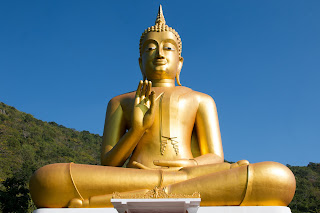
Golden Buddha
The Buddha is simple the historical figure you’re probably already familiar with, much like Jesus in Christianity. However, unlike Jesus, Buddha was a man exactly like you and me. We recognize Buddha as the enlightened one who discovered the path to liberation form cravings and clinging by leaving his princely life to one of self-discovery.

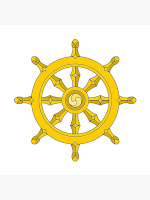
Dharma Wheel

The Dharma
are what we consider the Buddhas teachings. The three main teachings consist of The Four Noble Truths, The Noble Eightfold Path, and the Dhammapada, however there are a number of stories illustrating his wisdom and kindness. When you examine the Dharma you see the common themes of mindfulness, kindness and ethical conduct throughout. The Dharma is often represented by an eight spoked wheel.

Sangha
The Sangha is the spiritual group or community of Buddhists, much like a congregation is to a church. The Sangha is an important part of the spiritual community because it’s where we may learn from others who may be more advanced than we are but also from each other. Some examples of a Sangha are those living the monastic life, laypeople gathering to practice, or even viewers watching a talk on YouTube. The interpretation of a Sangha is all inclusive if you like.

So how do we incorporate the Three Jewels into our daily practice?

For me, I recite the following during my morning meditations.

I take refuge in the Buddha and the Buddha takes refuge in me.

I take refuge in the Dharma and the Dharma takes refuge in me.

I take refuge in the Sangha and the Sangha takes refuge in me.

Notice the second part, the phrase ‘takes refuge in me’. This is an important part of Buddhism; we are not separate from life; we are not separate from each other. This is a concept known as interbeing and as we take refuge in one of the jewels that jewel takes refuge in us.

So we may also think of these recitations as:

As I sit with the Buddha, the Buddha sits with me.

As I sit with the Dharma, the Dharma sits with me.

As I sit with the Sangha, the Sangha sits with me.

To me, this understanding, this connection to all life, is what makes Buddhism special to me. We are not dominate over anyone nor are we subservient to anyone; we are all precious and worthy. And in knowing this how can we be mean or cruel to one another?

With that, I invite you to explore this question more in-depth. I think you’ll find the answers liberating.


I wish you all peace and ease,

Vladimir

Thursday, February 3, 2022

How Social Norms Control Our Wellbeing

How A Pastor Released Guilt And Shame

Last week my family and I, including my in-laws from overseas, we all able to meet my mother and her husband for the first time. It was such an enjoyable experience for all of us. We rented a home in Florida for four-days along the Gulf of Mexico. Mornings were leisurely consisting of a light breakfast of coffee, fruits and vegetables, rice, and pastries.

Ocean, Seashore

After breakfast we would all go to the beach and collect shells, talk, and just enjoy all the beauty that nature has provided us along the oceanside. This was also the first time my daughter met my mother, her grandmother. There were many firsts, and sadly, a few lasts as well. My wife’s parents are elderly and live overseas making this trip potentially the last. This is a mindful moment.

One evening while we sat at the dinner table having coffee and dessert, my mother who also is Buddhist, began to relate to me the first time she went to the Thai temple in the late 1980s. She told me how different it was than what she has experienced at a Christian or Catholic Church. All the different ornamentations throughout, smells of incense burning, and even set-up of the hall was not like she had ever experienced. Overall, it was certainly an enjoyable experience.

But the revealing aspect to this entire experience was how she felt afterwards, a little guilty and a little shameful for going ‘against’ Christianity. How was she supposed to reconcile participating in a non-Judaic-Christian religious service? And that’s where a Pastor came in to help ease her mind.

At the hospital where she worked as an ICU nurse, she ran into the hospitals pastor where she began to relate this experience and her current dilemma regarding her feelings. The kind pastor, with a warm and inviting smile, said to her ‘out of all of the religions out there, Buddhism practices love, kindness, empathy, and compassion towards all beings and is in no way against what Christianity’s message promotes’. There was nothing for her to wrestle within her mind now. This too is a mindful moment. 

Cross, Sunset

But what I’d like for you to consider from this story is one of how society, and that may be any society, uses social norms to keep people behaving in a certain, safe, and predictable way. And that if you stray too far from what is acceptable, feelings of guilt, shame, and unworthiness begin to form and be watered. 

As I’ve talked about before in posts and during my Dharma livestreams, guilt and shame are controlling behaviors because we’ve conducted ourselves in some fashion outside of what is expected of us. And that conduct doesn’t even need to be harmful to others or ourselves to allow these feeling to begin grow.

When we live and follow the Noble Eightfold Path the Buddha has laid out for us, we know that our actions and thoughts are wholesome and positive right from our very intention. So it's important to be aware of when were feeling these controlling emotions. Recognize when we’re feeling them and say to them ‘I see you guilt’, ‘I see you shame’. Thank them for their brief visit and let them go. This too is a mindful moment.


I wish you peace and ease,


Vladimir

Blue Lotus Meditation and Mindfulness Center is a registered 501(c)(3) religious organization.

The Sixteen Imperfections of the Mind | The Eight Imperfections : Part 2 Subtle Distortions of Identity

As we continue, the first eight imperfections are loud and easy to recognize. The second eight are quieter. They hide behind respectability ...