Showing posts with label Noble Eightfold Path. Show all posts

Saturday, June 3, 2023

Opening Your Heart To Understanding Others


Life is like a box of chocolates…full of wonderful surprises, but sometimes we bite into something we may not like. And what you may not like someone else may find joy in. Likes and dislikes are as varied as flowers on the planet.

Box of Candy


With this myriad diversity of tastes is where we open our hearts so that we may better understand why someone may have a particular interests or behave in the way they did. We listen with mindful awareness.

Regardless of whether we like what we’ve bitten into, we have learned a valuable lesson. And with the right perspective this too is a positive.

What does it mean to open to others?

Opening to someone else's perspective shows you value them as a living being. It's not necessary that you even like their perspective or action. It's merely the acknowledgment of their existence that's truly powerful. Recall a time when something you said or did that was glossed over with a nonchalant shrug. Did you feel seen or valued at that time?

It shows that you are opening up to vulnerability.

This may be the hard part for most as we often view vulnerability as a weakness. Look at all of the tough guy movies people seem to love. Characters in these fictional stories are often the loner type with a grudge against the world. Ego gets involved and clouds your judgment. Think back to a time when you thought it was 'right' to be unmoving in front of someone else because you felt you couldn't show an imaginary weakens.

How to be open to others?

Friends listening and talking

Empathy. Recall a similar experience (hard or joyful) you faced; it doesn't need to be exactly like theirs. Don’t respond with ‘toughen up’ or ‘if I can do it, so can you’ or similar phrases. Phrases such as these are hurtful and suggest to the listener that their actions or feelings are less than.

Compassion. There’s nothing wrong with someone or yourself in being ‘soft’. Remember, the world is full of suffering. As Dharma and mindfulness practitioners, when we help ease the suffering of others, we help ease our own suffering. We also show compassion by adhering to personal boundaries. If we always say ‘yes’, we may be perpetuating suffering. Listening and not speaking while the other person is talking. Avoid saying ‘you should have / could have’ comments. Instead, if you have insightful suggestions phrase ‘have you tried’ or what works for me.

Avoiding gossip. Gossip perpetuates suffering and is neither nurturing nor developmental to ones wellbeing. Remember 'Right Speech' from the Noble Eightfold Path. When we listen to such talk, we are diminishing the persons experience in favor of a hurtful moment.

In order to understand someone we don’t necessarily need to have experienced the same exact situation as they. In fact, two people that experience the same situation may and often do take away completely differing experiences.

For example, when I was in Marine Corp boot camp, I had an enjoyable experience overall (don't get me wrong, it was still challenging!). Others, not so much and they had an extremely hard time. So, when we want to understand others suffering we need to open ourselves up with empathy and compassion to their experiences without judgment.

So as you bite into each new experience with someone be sure you do so with openness so that you may truly learn and potentially teach from the experience.


Wishing you continued peace and wellbeing,


Vladimir


You are warmly invited to follow on us on Facebook and Instagram at @bluelotuscenter for more ways to improve your mindfulness practice and wellbeing.

Blue Lotus Meditation and Mindfulness Center is a registered 501(c)(3) religious organization.

Website and monthly newsletter: www.bluelotusmeditation.us

For guided meditations and Dharma talks, please visit and subscribe to our YouTube channel.

Facebook

Instagram

Tuesday, May 23, 2023

Purpose And Goals: A Mindful Approach

Purpose and goals. These are two words we frequently hear and often misuse. What is your purpose in life? Where do you see yourself in five years? Let's explore the differences and see if there may be an overlap between the two.

Crossroads

In living, sentient beings, purpose is not function or usefulness. Purpose is simply 'meaning' in the spiritual sense and may only be bestowed on a living, sentient being. A screwdriver cannot have 'purpose' because it is not alive, obviously.

Whereas a goal is a desire that may only be accomplished in the future. Therefor once it’s been achieved it’s no longer a goal. I would like to eat lunch today. I see myself as a business owner. Or I would like to finish college by next year. As you see we may have many goals in life.

Do you need 'purpose' to live a meaningful life? We all would like to think so. We would like to think that our existence will have a positive impact on at least one person. So, the question of ‘do I have purpose’ may weigh heavy on your mind.

So how do we answer this question from a Buddhist and mindfulness perspective? For this discussion we are going to exclude any notion of divinely derived causality for our existence and simply look at what the Buddha taught.

When we look at Buddhas very first teaching he explains the Four Noble Truths: There is suffering in the world, attachment is the cause of suffering, there is a way to end suffering, and that way is the Noble Eightfold Path.

No one wants to suffer and that’s why we have goals. We hope that with a college degree we may get a better job which will ease our suffering. Or maybe we’d like a bigger house in the country away from the hustle and bustle of city life. Or perhaps we'd like to move into the city because country life is too quiet.

But accomplishing any one or more of these goals will not ease your suffering for any meaningful length of time. If you get a bigger home, then you might need to worry about protecting your possessions and get a security system. Certainly this scenario cannot be the purpose of your life, can it? 

Supportive Friends

Let’s circle back to the First Noble Truth, there is suffering in this world. Since we know this to be a factual statement then couldn’t our purpose be to help ease the suffering of others? Rather than focusing on ‘I” or “me’ as we have been taught instead, we shift our perspective to ‘we’ and ‘others’. This paradigm shift is certainly meaningful, for what greater good can there be than helping those that are suffering.

Buddhism isn’t about achieving enlightenment or Nirvana. These outcomes may be the result of the practice and maybe not even in this lifetime. The heart of Buddhism is easing suffering for us and others and the way to accomplish this is through the Noble Eightfold Path. Following this path, even to a small degree, helps you change your outlook to one that is purposeful and meaningful instead of one that is materialistically goal orientated.

Do you need purpose to have a meaningful life? The simple fact is you already do. It’s an innate quality of being born a sentient being and a quality that is often overlooked in our busy and distracted lives.


Wishing you continued peace and wellbeing,


Vladimir


You are warmly invited to follow on us on Facebook and Instagram at @bluelotuscenter for more ways to improve your mindfulness practice and wellbeing.

Blue Lotus Meditation and Mindfulness Center is a registered 501(c)(3) religious organization.

Website and monthly newsletter: www.bluelotusmeditation.us

For guided meditations and Dharma talks, please visit and subscribe to our YouTube channel.

Facebook

Instagram

Saturday, May 13, 2023

Dealing With The Anger Inside

We all experience anger at times and it’s important to determine the true cause of our anger. But before we do, I’d like to point out a common saying when it comes to anger and that is ‘it’s a normal human emotion’. So, I’d like to examine this very notion a little more.

We often associate ‘normal’ with ‘healthy’ and this misunderstanding contributes to more suffering. There are many things in this world that are ‘normal’ but unhealthy, radioactivity comes to mind. Radiation is a normal byproduct of some natural elements as they decay but exposure results in harmful effects to the living organisms. Anger is in the same category, normal but harmful.

Buddha, Elephant, Anger

When we examine the Buddhas wise words we come across where he talks about the three poisons – greed, anger, and ignorance and their destructive power. And he goes on to mention how each of these three poisons or mental conditions feed off one another. If we don’t get what we want (greed) we get angry. And when we get angry, we act without clear thought to try to acquire what we didn’t get (greed) in the first place. It becomes a perpetual cycle of suffering even though the specific object of our desire may change.

So how may we, with mindful awareness and care, minimize the harmful effects of anger?

The very first step is to recognize that we are angry. This may sound simple but can be difficult when we’re ‘in the heat of the moment’. Too often we don’t recognize the initial stages of anger, tight lips, tight chest, sweating, or beginning to feel hot, until it’s too late.

Once we recognize we are angry it’s important to accept that we are angry. Not at someone else but that we ourselves are angry. Anger is a condition that we have allowed to rise and as with all emotions we are solely responsible for it, no one else. Acceptance is taking responsibility for that response and not trying to bury or hide it with shame or guilt. For when we take responsibility for an emotion, we are then able to care for it which is our next step.

Caring for an emotion might sound funny, especially for one that has been described as a poison. But, caring for it is exactly what we must do.

Father, baby
Consider a screaming child, one who perhaps had a bad dream. We would never consider yelling at a child in such a state of fear to ‘be quiet’ or ‘go back to bed’. Instead, what would we do? We would hold and comfort the child, reassuring them that all is well and that they are safe. Soon, the child is fast asleep and back in their bed.

The same holds true with anger. We don’t fight it, nor do we ‘give in’ to it. Instead, we say ‘let me hold, comfort, and reassure you that you are safe’. When beings, and emotions, have feelings of warmth and security the only natural response is one of happiness, joy, and nurturing.

You too have the capacity to overcome anger and replace it with something more helpful and constructive and the Buddha has shown us a path to walk upon, The Noble Eightfold Path.


Wishing you continued peace and wellbeing,


Vladimir


You are warmly invited to follow on us on Facebook and Instagram at @bluelotuscenter for more ways to improve your mindfulness practice and wellbeing.

Blue Lotus Meditation and Mindfulness Center is a registered 501(c)(3) religious organization.

Website and monthly newsletter: www.bluelotusmeditation.us

For guided meditations and Dharma talks, please visit and subscribe to our YouTube channel.

Facebook

Instagram


Sunday, March 13, 2022

The Three Jewels of Buddhism

In Buddhism there are what as known as ‘The Three Jewels’ and each of these jewels represents a wonderful place of refuge. Remember, as the Buddha revealed to us in the Four Noble Truths, life will constitute moments of suffering or displeasure or unhappiness. And a refuge is a place where way may seek sanctuary or safety during these, and any other moments for that matter, of our lives.

The Three Jewels are: The Buddha, The Dharma, and The Sangha.

But what do they mean? How may we meaningfully incorporate them into our lives?

Let’s first examine what they mean.

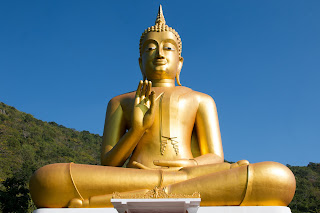
Golden Buddha
The Buddha is simple the historical figure you’re probably already familiar with, much like Jesus in Christianity. However, unlike Jesus, Buddha was a man exactly like you and me. We recognize Buddha as the enlightened one who discovered the path to liberation form cravings and clinging by leaving his princely life to one of self-discovery.

Dharma Wheel

The Dharma
are what we consider the Buddhas teachings. The three main teachings consist of The Four Noble Truths, The Noble Eightfold Path, and the Dhammapada, however there are a number of stories illustrating his wisdom and kindness. When you examine the Dharma you see the common themes of mindfulness, kindness and ethical conduct throughout. The Dharma is often represented by an eight spoked wheel.

Sangha
The Sangha is the spiritual group or community of Buddhists, much like a congregation is to a church. The Sangha is an important part of the spiritual community because it’s where we may learn from others who may be more advanced than we are but also from each other. Some examples of a Sangha are those living the monastic life, laypeople gathering to practice, or even viewers watching a talk on YouTube. The interpretation of a Sangha is all inclusive if you like.

So how do we incorporate the Three Jewels into our daily practice?

For me, I recite the following during my morning meditations.

I take refuge in the Buddha and the Buddha takes refuge in me.

I take refuge in the Dharma and the Dharma takes refuge in me.

I take refuge in the Sangha and the Sangha takes refuge in me.

Notice the second part, the phrase ‘takes refuge in me’. This is an important part of Buddhism; we are not separate from life; we are not separate from each other. This is a concept known as interbeing and as we take refuge in one of the jewels that jewel takes refuge in us.

So we may also think of these recitations as:

As I sit with the Buddha, the Buddha sits with me.

As I sit with the Dharma, the Dharma sits with me.

As I sit with the Sangha, the Sangha sits with me.

To me, this understanding, this connection to all life, is what makes Buddhism special to me. We are not dominate over anyone nor are we subservient to anyone; we are all precious and worthy. And in knowing this how can we be mean or cruel to one another?

With that, I invite you to explore this question more in-depth. I think you’ll find the answers liberating.


I wish you all peace and ease,

Vladimir

The Sixteen Imperfections of the Mind | The Eight Imperfections : Part 2 Subtle Distortions of Identity

As we continue, the first eight imperfections are loud and easy to recognize. The second eight are quieter. They hide behind respectability ...