Showing posts with label meditation. Show all posts

Wednesday, September 9, 2026

What the Buddha Said About the Self


Mind as the Forerunner

The Dhammapada opens with a teaching so foundational that an entire life of practice could rest on it alone: mind is the forerunner of all things. Act from a defiled mind, and suffering follows, as a wheel follows the hoof of an ox. Act from a clear mind, and happiness follows, like a shadow that never departs (Dhammapada 1:1 - 2).

Suffering and liberation aren't things that happen to us from outside. They arise from the quality of the mind, and the mind that constructs suffering is the very mind that can be trained to release it. This isn't fatalism. It's radical agency. But before we can do that work, we have to understand what we're working with. We have to understand this thing we call "the self."

The Burden of the Self

In the Khandha Samyutta, the Buddha describes what we ordinarily call "self" as five aggregates - heaps that arise together and get mistaken for one unified, permanent "me": form (the body), feeling (the pleasant, unpleasant, or neutral tone of experience), perception (labeling and recognition), mental formations (thoughts, intentions, habits), and consciousness (bare awareness).

In the Anattalakkhana Sutta, the very first teaching he gave after his enlightenment, the Buddha asks whether any of these five is truly "self." The body ages and sickens against our wishes. Feelings arise and vanish without permission. None of it can be commanded: let my form be thus, let my form not be thus. Applied to all five aggregates, the conclusion is the same: nothing fixed, permanent, or separate can be found. And yet, something is here. Something knows.


No-Self Is Not Nothingness

Anatta, "no-self," may be the most misunderstood teaching in Buddhism. The Buddha wasn't saying you don't exist, he was saying the self you believe yourself to be, fixed and separate, isn't what you actually are.

In the Milindapanha, the monk Nagasena offers a lamp burning through the night: is it the same flame at midnight as at dawn? Not exactly, but not a different flame either. A river flows, same river, different water. You are like this: a flowing process, a stream of causes and conditions. Not a noun. A verb.

The Dhammapada states it plainly: "All conditioned things are impermanent... All conditioned things are suffering... All phenomena are non-self" (277–279). Seeing this directly, not just agreeing with it intellectually, doesn't lead to despair. It leads to weariness with clinging, then dispassion, then liberation.

What Are We Holding?

A student once asked the Buddha what refuge exists amid the flood of aging, sickness, and death. His answer: possessing nothing, clinging to nothing, this is the island (Sutta Nipata 5:10).

What are we clinging to? Not just possessions, but the identity we've constructed and must constantly maintain: competent, spiritual, wronged, special, worthless. In the Madhupindika Sutta, the Buddha traces a chain: contact leads to feeling, feeling to perception, perception to thinking, thinking to a proliferation of concepts, including the concept of "I." We mistake the concept for reality and organize our lives around defending it.

Elsewhere, he offers an image: a person watching a river sees foam drifting by. A fool grabs at it; a wise person sees it's hollow, not worth grasping. The self is like the foam.

Impermanence as the Doorway

Among the Buddha's last words, lying between the twin sala trees: "All conditioned things are impermanent. Work out your salvation with diligence" (Digha Nikaya 16).

You don't need scholarship to verify this, just your own experience. Nothing stays the same. Yet we suffer by trying to make permanent what is, by nature, temporary: clutching at pleasant feelings, resisting the passing of unpleasant ones, gripping the people we love out of fear of losing them. Of the five kinds of clinging the Buddha names, the deepest and most hidden is clinging to the idea of a permanent self. When impermanence is truly felt, not just known, that clinging begins to release, because the ground it stood on turns out to be sand.

The Raft

In the Alagaddupama Sutta, a man builds a raft from reeds and grass to cross a dangerous stretch of water. Once across, should he carry the raft on his head for the rest of his journey? Of course not, he sets it down and continues on foot.

The Dhamma is like that raft, the Buddha says. It is for crossing, not for carrying. Even the teaching itself isn't meant to be clung to, and if that's true of the Dhamma, it's even truer of the constructed self, assembled from impermanent parts and conditioning we never chose. Letting go isn't loss. Setting the raft down is arrival.

What Remains

When clinging loosens, what's left isn't emptiness. In the Udana, the Buddha points to "an unborn, unbecome, unmade, unconditioned", something not produced by causes and conditions, and therefore not subject to their passing away.

In the Itivuttaka, he calls this the luminous mind, citta pabhassara, radiant at its core, only obscured by visiting defilements. Confusion visits. Fear visits. Craving visits. But they are guests, not the host. What you fundamentally are was never wounded and will never be lost.


The Path: Mindfulness and Compassion

The practical instruction for releasing the constructed self appears in the Satipatthana Sutta: sitting, breathing, observing the body as body, not "my" body, and feelings as feelings, not "my" feelings. This small shift, from identification to observation, is where the unwinding of clinging begins. In the Samyutta Nikaya, the Buddha compares this to a fletcher straightening an arrow, not by force, but through sustained, even attention.

A reliable sign the practice is working: compassion grows. It's counterintuitive to the ego, which fears that losing its boundaries means becoming vulnerable, but the defended, contracted self is actually the most limited in its capacity to care. In the Metta Sutta, the Buddha calls for a heart as boundless as a mother's love for her only child. And to Ananda, who suggested good friendship was half the holy life, the Buddha corrected him: "Good friendship is the whole of the holy life" (Samyutta Nikaya 45:2).

Kisa Gotami

One of Buddhism's most beloved stories: a young mother named Kisa Gotami, mad with grief after her infant son's death, begged the Buddha for medicine to revive him. He agreed, on the condition that she first bring back a mustard seed from any household untouched by death.

She went door to door. Every household had lost someone, a parent, a child, a spouse. By the time she returned, she already understood. She buried her son, took refuge, and practiced. Her own words of awakening survive in the Therigatha: "I have washed my hands of it. It is finished. I am free." What changed wasn't her circumstances, her son was still gone. What changed was her relationship to a truth she'd always been living inside. Private suffering cracked open into the common human condition, and something loosened.

The Chariot

King Milinda once asked the monk Nagasena to locate the "self" the way you might locate a chariot. Is the chariot the axle? The wheels? The frame? None of these alone, nor even all of them combined, is "the chariot" in any fixed sense, the word is simply useful, conventional. So too with "I": useful, necessary for language, but not findable as a fixed, independent thing behind experience. What cannot be found cannot be clung to. And what cannot be clung to is freedom.

The Open Hand

Imagine a closed fist, holding everything you take yourself to be, your history, your wounds, your achievements, your story of what you deserve. Now, slowly, open the hand. Not to throw anything away. Just to open.

Asked where suffering comes from, the Buddha answered: from attachment, from whatever we call "mine." The way across is to let go of what is below, what is above, what is in the middle, until there's no location left for clinging to hide. What's revealed isn't absence. It's the awareness that was always there, before the story, before the concept of "I" colonized every moment.

Returning to the Breath

The Buddha's instructions on mindfulness of breathing are simple: breathing in, know you are breathing in. Breathing out, know you are breathing out. Nothing more elaborate is required. This is available right now, this breath, this one.

This week, notice where you are gripping. Not to condemn it. Not to fix it. Just to see. The seeing is itself the beginning of release.

"Hard it is to train the mind, which goes where it wishes and does what it wants. But a trained mind brings happiness." - Dhammapada 35

The destination the Buddha pointed to, again and again across forty-five years of teaching, was never elsewhere, never after death, never in another life. It is here - when clinging stops, even for a moment, even now.


Watch the full Dharma talk here: 


Vladimir

Sathu. Sathu. Sathu.

Buddham Saranam Gacchami 

***********************************************************************************

Vladimir imparts the Buddha's Dharma with warmth and skill, filling the world's deep need for loving-kindness, compassion, and empathy. 

To learn more about us and for free mindfulness and mediation resources you are warmly invited to visit: www.bluelotusmeditation.us 

Looking for a way to help guide others? Become a Blue Lotus Aspirant here: https://bluelotusmeditation.us/continue-your-journey 

US Tax deductible donations may be offered here: https://www.paypal.com/donate/?hosted_button_id=88BRNH3K7Y7FQ 

Blue Lotus Dharma & Meditation Center is a 501(c)(3) Buddhist society.

Tuesday, March 17, 2026

The Sixteen Imperfections of the Mind | The Eight Imperfections : Part 2 Subtle Distortions of Identity

As we continue, the first eight imperfections are loud and easy to recognize. The second eight are quieter. They hide behind respectability and often disguise themselves as confidence or maturity.

These subtler distortions can be difficult to see, but mindfulness gently reveals them. What we are willing to examine loses its unconscious power.

Let's continue:

9. Hypocrisy (Māyā): Presenting oneself as better than one truly is. Mindfulness invites authenticity.

10. Fraudulence (Sāṭheyya): Deception for personal gain. Awareness fosters radical honesty.

11. Obstinacy (Thambha): Rigid refusal to reconsider views. Mindfulness softens identification with opinions.

12. Presumption (Sārambha): Competitive superiority. Mindfulness replaces comparison with cultivation.

13. Conceit (Māna): The measuring mind: better, worse, equal. Awareness dissolves comparison.

14. Arrogance (Atimāna): Inflated self-importance. Mindfulness grounds us in impermanence.

15. Vanity (Mada): Clinging to youth, status, or praise. Awareness reveals change in real time.

16. Negligence (Pamāda): Spiritual carelessness or forgetting. Mindfulness restores diligence and wakefulness.

Negligence, that quiet forgetting, is often the doorway through which the others return. When we forget to pause, forget to breathe, forget that this moment is practice, the mind drifts.

The Buddha’s final exhortation, recorded in the Mahāparinibbāna Sutta, urged diligence and heedfulness. I hear that not as pressure, but as tenderness, a reminder not to drift through this precious life asleep.

What reassures me most is this: the presence of an imperfection is not failure. The willingness to see it is awakening beginning to move.

The presence of an imperfection is not failure. The willingness to see it is awakening beginning to move. Each moment of mindfulness is a quiet turning of the heart toward freedom.

Each moment of mindfulness, each honest recognition, is a quiet turning of the heart toward freedom.


And perhaps that is enough for today.


Vladimir

Sathu. Sathu. Sathu.

Buddham Saranam Gacchami 

***********************************************************************************

Vladimir imparts the Buddha's Dharma with warmth and skill, filling the world's deep need for loving-kindness, compassion, and empathy. 

To learn more about us and for free mindfulness and mediation resources you are warmly invited to visit: www.bluelotusmeditation.us 

Looking for a way to help guide others? Become a Blue Lotus Aspirant here: https://bluelotusmeditation.us/continue-your-journey 

US Tax deductible donations may be offered here: https://www.paypal.com/donate/?hosted_button_id=88BRNH3K7Y7FQ 

Blue Lotus Meditation and Mindfulness Center is a 501(c)(3) Buddhist society.

Sunday, March 1, 2026

The Sixteen Imperfections of the Mind | The First Eight Imperfections — Part 1

As long as I've been a mindfulness practitioner, I do not have to look very far to find these imperfections in my own mind. They appear in small moments, a flash of irritation in traffic, a subtle comparison scrolling online, a quiet resentment I replay longer than I should.

Sometimes I even think that even after all of these years these momentary flashes should have abated by now, but I truly know better. These fleeting instances do not define the practice nor do they define how well I've progressed. Instead they are part of the Sixteen Imperfections of the Mind which are not abstract doctrines; instead they are lived realities.

In the early teachings of the Buddha, particularly within the framework of the five hindrances, we find careful descriptions of the forces that cloud clarity. These teachings are not condemnations but invitations. They help us see what is already happening within us.

Mindfulness (sati) has become a gentle light. It does not scold. It reveals. And when something is clearly seen, it begins to loosen its grip.

1. Covetousness (Abhijjhā): The restless reaching toward what is not present. Mindfulness reveals the instability of desire and cultivates contentment.

2. Ill Will (Byāpāda): Aversion hardened into hostility. Mindfulness exposes its physical and emotional signature and opens the door to loving-kindness.

3. Anger (Kodha): Emotional fire that can be known without being acted upon. Mindfulness creates space between impulse and reaction.

4. Hostility (Upanāha): Sustained resentment. Awareness interrupts the rehearsal of grievance.

5. Denigration (Makkha): Belittling others to protect insecurity. Mindfulness invites honest self-inquiry.

6. Domineering (Paḷāsa): The need to control or assert superiority. Mindfulness replaces striving with steady presence.

7. Envy (Issā): The pain of comparison. Mindfulness transforms comparison into gratitude.

8. Stinginess (Macchariya): Withholding generosity or goodwill. Awareness softens fear and encourages openness.

When I first encountered this list, I felt a subtle discomfort, as if someone had been reading my private thoughts. But over time, I began to see compassion in these teachings. They assume we are human. They assume we struggle. And they offer a path forward.

Mindfulness is not about becoming flawless. It is about becoming honest. Each time we notice an imperfection without identifying with it, something shifts toward freedom.

Be sure to come back in 2 -weeks for part two of this series on The Sixteen Imperfections of the Mind


Vladimir

Sathu. Sathu. Sathu.

Buddham Saranam Gacchami 

***********************************************************************************

Vladimir imparts the Buddha's Dharma with warmth and skill, filling the world's deep need for loving-kindness, compassion, and empathy. 

To learn more about us and for free mindfulness and mediation resources you are warmly invited to visit: www.bluelotusmeditation.us 

Looking for a way to help guide others? Become a Blue Lotus Aspirant here: https://bluelotusmeditation.us/continue-your-journey 

US Tax deductible donations may be offered here: https://www.paypal.com/donate/?hosted_button_id=88BRNH3K7Y7FQ 

Blue Lotus Meditation and Mindfulness Center is a 501(c)(3) Buddhist society.


Thursday, January 15, 2026

Your Six Senses And The Material World Around You

In much of the Western world, we are taught that human experience is shaped by five senses: sight, sound, smell, taste, and touch. These senses are often presented as the complete framework through which we perceive reality. While this understanding is helpful, it is incomplete when viewed through the lens of Indian philosophy and Buddhist teachings.

In Buddhism, human experience is understood through six senses, not five. The first five are the same as those commonly recognized in Western thought. The sixth sense, however, is the mind, also referred to as the sense center. This is not a supernatural faculty or psychic ability, but a very practical and observable aspect of everyday experience.

In modern language, the sixth sense can be understood as the brain and mental processes that receive and interpret sensory input. It is through this sense center that sights, sounds, smells, tastes, and physical sensations are processed and given meaning. Without the mind, the other five senses cannot create a coherent experience of the world.

Man meditating
For example, the eye may see color and shape, but it is the mind that recognizes “a tree.” The ear may detect vibration, but it is the mind that labels it as “music” or “noise.” In this way, the sixth sense acts as the organizer of experience, allowing us to navigate the world with understanding and perspective.

Because the mind plays this central role, it is also the primary location where suffering begins. When the sense center operates without mindfulness, it reacts habitually. Pleasant experiences lead to craving, unpleasant experiences lead to aversion, and neutral experiences are often ignored altogether.

From these automatic reactions arise attachment, delusion, and wrong view. We begin to believe that experiences are permanent, that they define who we are, or that they can provide lasting satisfaction. These misunderstandings distort reality and keep us caught in cycles of dissatisfaction and stress.

The Buddha taught that by guarding the sense doors, particularly the mind, we can interrupt this cycle. Guarding does not mean suppressing thoughts or avoiding experience, but rather meeting each moment with awareness and restraint. This mindful presence prevents unwholesome reactions from taking root.

Through mindfulness and meditation, we learn to observe thoughts, emotions, and perceptions as they arise and pass away. We begin to see that they are conditioned, impermanent, and not-self. This insight loosens the grip of attachment and weakens the patterns that lead to suffering.

As wisdom develops, the mind becomes less reactive and more spacious. Instead of being driven by craving or fear, we respond with clarity and compassion. The six senses are still active, but they no longer dominate us in the same way.

By understanding the six-sense framework, especially the role of the mind, we gain a powerful tool for liberation. When the sense center is guided by mindfulness and right understanding, it becomes a gateway to freedom rather than suffering. This is the heart of the Buddha’s teaching and a practical path toward lasting peace.


Vladimir

Sathu. Sathu. Sathu.

Buddham Saranam Gacchami 

***********************************************************************************

Vladimir imparts the Buddha's Dharma with warmth and skill, filling the world's deep need for loving-kindness, compassion, and empathy. 

To learn more about us and for free mindfulness and mediation resources you are warmly invited to visit: www.bluelotusmeditation.us 

Looking for a way to help guide others? Become a Blue Lotus Aspirant here: https://bluelotusmeditation.us/continue-your-journey 

US Tax deductible donations may be offered here: https://www.paypal.com/donate/?hosted_button_id=88BRNH3K7Y7FQ 

Blue Lotus Meditation and Mindfulness Center is a 501(c)(3) Buddhist society.

Tuesday, August 26, 2025

Leaving A Toxic Environment

Last week I met with one of our newer practitioners, whom we'll refer to as Jane, who then related a personal conversation they had with their supervisor. The succinct version of the interaction was that after many years upon being transferred to a new project, the supervisor mentioned to Jane was that she was taking more sick time on this new team than she had previously with her former team. The supervisor was not upset but merely making an observation, as Jane has plenty of 'sick time'. 

Even though there was no ill-intent on the supervisors part this still caused Jane to pause.

Had she taken more sick time than usual?

Reflecting on the transfer more mindfully, Jane knew that she would be going from a high stress project to one with little to no stress. But what she did not realize were the mental and physical changes that were going to transpire as a result.

After about a month into the new project Janes mind and body felt 'different'. And this new feeling felt 'odd' and 'uncomfortable' so like anyone she made an appointment with her physician to see if there was anything wrong. After all of the testing, the doctor gave her the good news that all of the results were normal.

This was certainly good news but it did not explain how she was feeling. 

It was not until our weekly meeting that the veil of uncertainty was lifted.

After many years, her mind and body were detoxifying from undue mental stress and she was returning to a more relaxed state of existence.

As we explored more of this new state of balance I made the comparison to someone being severely injured and not knowing about the injury until the situation calmed down. Janes situation was much the same. She did not realize her mind and body were injured until the situation changed for the better. It was akin to her living in a continuous 'fight' mode before to now one where the threat had diminished. 

The 'fight' mode she had been living in, no matter how harmful, had become comfortable.

These same heightened mental and physical responses can happen to anyone, and oftentimes as in Janes example, it was unrealized. 

Some occupations that come to mind are police, firemen, and doctors, but as in Janes case she was not in any of these career fields, she works in a office setting.

But occupations are not the only situations where someone may experience significant stress. 

Consider the spouse or significant other who is in an abusive relationship. 

Or those that have experienced a sexual assault. 

Or someone addicted to alcohol or drugs. 

Or the child who gets bullied at school or even at home. 

Doctors may or may not be trained to ask all types of personal questions so that is where a dedicated mindfulness meditation practice come in. 

Mindfulness and meditation allows one to be aware of even the most minutest of changes in both mind and body. After sufficient skill development a mindfulness practitioner will recognize the agitation, explore it more deeply, and then send it on its way.

Jane continues to meet with me in both one-on-one settings as well as individual meetings and she has progressed very nicely in that time.


Sathu. Sathu. Sathu.

Educate Your Mind With The Dharma.
 
**********************************************************************************************
Vladimir warmly and skillfully passes on the Buddhas Dharma to a world in need of loving-kindness, compassion, and empathy for the benefit of all living beings.
 
To learn more about us and for free mindfulness and mediation resources you are warmly invited to visit: www.bluelotusmeditation.us
 
Looking for a way to help guide others? Become a Blue Lotus Aspirant here: https://bluelotusmeditation.us/continue-your-journey
 
US Tax deductible donations may be offered here: https://www.paypal.com/donate/?hosted_button_id=88BRNH3K7Y7FQ
 
Blue Lotus Meditation and Mindfulness Center is a 501(c)(3) Buddhist society.

Thursday, July 31, 2025

On Being 'Insert Emotion Here'.

When we experience an emotion we typically say 'I am angry' or 'I am sad'...or I am whatever emotion is being experienced at the time.

'I am' described a quality that something possesses as part of it's characteristics. For example, a Red Delicious apple will always be red. It will never be orange or yellow. It's coloring will never change. 

Your emotions, on the other hand, will.

You are not always angry, happy, sad, or melancholy. In fact, on any given day you may experience all of these emotions for different lengths of time and even intensities.

A monk best described emotions to me as this: emotions are like tools in a tool box. You only use the right tool for the right job and when you're finished you put the tool back.

Too often we allow ourselves to carry an emotion for far too long. The longer we carry it, the less useful it is. This not only applies to the emotions we consider 'negative' like anger but applies just as much to the 'positive' emotions like elation.

Why is this?

It's simply because we have not realized or accepted the moment has passed. We desire to stay there even if we feel it is hurtful.

All conditions, without exception, have the quality of impermanence. And it is within impermanence that we may take comfort as well.

We may consider impermanence as the 'toolbox' in which our emptions reside. When we need joy we reach into our emotional toolbox and use 'joy'. When we are finished, we simply put it back for future use.

But some toolboxes don't get replaced. Instead the tool, or emotion in this case, stays with the person, much like a toolbelt. After awhile the toolbelt gets full, cumbersome to carry, and noisy as we walk. We no longer need the hammer, but we choose to carry it anyway. 

In other words, we hold on to said 'emotion' too long and it becomes counter productive to living in the moment appropriately, this emotion no longer serves to your advantage. We bring about suffering by attachment. 

Now we may ask how long is a moment. A moment certainly is not a decade, a year, a even a month. To some degree, this depends on the individual circumstance. The death of a dear loved one or a birth may last a week or so. However a graduation may only last a few hours. Making the red light so you are not late to work may only last a few seconds.

It is important for each of us to be sure that we use our emotions appropriately and that we return them to our toolbox so that we do not end up carrying too much of a load in our daily lives. If we do, we end up risking our mental well-being because after all, you are much more than any single emotion.


Sathu. Sathu. Sathu.
 
Educate Your Mind With The Dharma.
 
**********************************************************************************************
Vladimir warmly and skillfully passes on the Buddhas Dharma to a world in need of loving-kindness, compassion, and empathy for the benefit of all living beings.
 
To learn more about us and for free mindfulness and mediation resources you are warmly invited to visit: www.bluelotusmeditation.us
 
Looking for a way to help guide others? Become a Blue Lotus Aspirant here: https://bluelotusmeditation.us/continue-your-journey
 
US Tax deductible donations may be offered here: https://www.paypal.com/donate/?hosted_button_id=88BRNH3K7Y7FQ
 
Blue Lotus Meditation and Mindfulness Center is a 501(c)(3) Buddhist society.

Friday, June 23, 2023

Exploring Mindfulness For Teens

Being a teen in this day and age is much different than when your parents were your age. I'm sure you've heard this before. This same sentiment was certainly felt when your grandparents talked to your parents as well about most of the same concerns. If you choose to have children, these same feelings and sentiments will be expressed to them. It's a normal cycle from parent to child. 

Teens
But for now, let's explore mindfulness today and how it will benefit your current as well as your future wellbeing. Your thoughts and concerns about so many changes and new experiences may all seem overwhelming. So as you read this know that this time, right now is all about you, your relationship with your parents, teachers, friends, the future, and the most important relationship you’ll ever have: with yourself.

So many aspects of your life are at a point where they may feel like they just want to burst out. This is normal. Our bodies experience many different sensations that are a result of our brains releasing different hormones into our system. This may, at times even manifest itself in an uncomfortable physical sensation. 

Sometimes, depending on the intensity of the sensation our mind may construct some type of story which oftentimes isn't true. We may feel overly sensitive to some from of rejection when there was no intended malice. Before we respond, we need to mindfully examine the situation for what is is and not what we 'think' it is. 

So when we experience these uncomfortable sensations it is important to recognize these conditions in the moment so we may bring mindful awareness to them. Remember, being mindful is also being non-judgmental towards having those feelings.

Teen, Parent

As a teen I'm sure you have many different types of relationships, but how do you walk a wholesome path with your relationships? 

How do your peers feel? Your peers have the exact questions as you and are experiencing the same feelings of uncertainty you are, although they may express it differently.

Some common questions you may have are:

    - Do my friends like me? Sure, they're your friends!

    - What will I do after high school? Does it truly matter? I promise you it doesn't but what does matter is how kind you are. That's what people will remember.

    - Are you the class clown? This 'hey, look at me' suggests that one is desiring affirmation or some form of positive reinforcement from a bad behavior. A sarcastic remark perhaps?

    - Social media presence. Keep it 'G - Rated'. There was an old saying during World War II that went 'loose lips, sink ships'. You don't want that sinking ship to be yours next week, next year, or five-years from know. Besides, you shouldn't be doing hurtful things anyway, right?

    - Parents. Yes, they love you and yes, they're proud of you. Sometimes parents get mad at you because of 'their' expectations for you. It's an extension of their world view that doesn't necessarily align with yours. Be cool about it and simply bring awareness to the fact that they don't want to see you hurt.

    -Teachers. This is a hard job, no question about it. Imagine you coming into work each day and seeing probably over 100 different people each with their own unique personality and needs going through life changes. Not to mention teachers are people too that are also dealing with sometimes stressful life events. Be empathetic and compassion towards them. 'After' you graduate recall a few of the good ones and friend them on Facebook (old people don't use Snapchat) and keep in contact with them. Knowing they made a positive difference in a students life is truly why they're in the profession.

    - Yourself. You will always have you. The face in the mirror will change as you get older but your essences will always be 'you'. Long after your body has ceased to exist, your conscience will always be there. Do good and engage in kind actions in this life so that you have a better future in this life and the next.

As you begin to experience more situations it’s important to start now to develop the necessary skills to mindfully address not only adversity and disappointment but overwhelming joy and good times as well. Both circumstances can lead to additional suffering if not viewed appropriately.

How can too much joy cause suffering?

When either side of our emotional state is out of balance suffering occurs but when we are too overjoyed for too log we develop an emboldened ego. This leads to feelings of superiority which may lead to risk taking behavior.

You will make mistakes along the way, we all do, including adults, and the mistakes we make aren’t the problem. It’s living in them long after they have occurred. Learning to let go of guilt and shame are liberating and allow you to experience life in a more wholesome way. Learning to let go also holds true to those who may have hurt you.

So how can you, as a teen, begin mindfulness practice?

Meditation is certainly involved in the process but even before you begin this truly search your feelings before you speak or engage in an action. Ask yourself, is it wholesome?

Be certain to help others. Look at service activities at your school (homeless, food pantry, relief funds). Being of service to others develops empathy and compassion and lets go of greed and callousness.

Do your best to try and not wish away your life. Statements like 'I can’t wait until I get my drivers license, or go off to college' take you out of the present moment. Being mindful is about being in the present moment, not the future nor the past.

Apologize first, no matter what the offense. This offers grace and compassion to both of you.

Use kind speech and don’t be sarcastic. The humor wears out quickly and is unappealing even when people laugh.

And last but not least, join our teen sangha - it’s free Wednesdays at 3:30 PM CST. It's important to have a mindful community to help you along.


Wishing you continued peace and wellbeing,


Vladimir


You are warmly invited to follow on us on Facebook and Instagram at @bluelotuscenter for more ways to improve your mindfulness practice and wellbeing.

Blue Lotus Meditation and Mindfulness Center is a registered 501(c)(3) religious organization.

Website and monthly newsletter: www.bluelotusmeditation.us

For guided meditations and Dharma talks, please visit and subscribe to our YouTube channel.

Facebook

Instagram


Tuesday, June 13, 2023

Mindfulness As A Family Practice

Mindfulness and meditation isn't a way of life that's about solitude or sequestering ourselves from others. In fact, it's very much the opposite. When we look at the purpose of mindfulness and meditation we see that it’s focus is on connections and the easing of suffering. Not only our suffering but others as well.

This inherent nature makes a mindfulness and meditation practice ideal for the family that will help strengthen this vital relationship.

Let's explore ways to include the family.

As is often the situation whenever there's a new aspect involving family it’s not uncommon that we find some resistance. This resistance is often true with teens but may present itself in anyone. As a mindful behavior we don’t force or shame anyone to try these practices.

Be the roll model. It's important to let others witness first hand the benefits that come from a mindfulness practice. But as a reminder, these benefits don't appear over night so be patent.

Here are some wonderful and readily available home examples:
  • Let family members visible see you practice mindfulness
  • Mindful walking
  • Outside and in the home
  • Journaling
  • Cooking
  • Eating
  • Cleaning
  • Driving
  • Shopping
  • Talking
  • Laundry
  • Even meditation

As you mindfully engage these activities invite someone to try any one of the above (or more) mindful actions. For the resistant family member you can even ask them mindful questions nonchalantly.

For example, if you're cutting a carrot for a salad ask them ‘where do you think this carrot came from’? Prompting them to go from the store all the way back to the farm.

Follow up by asking ‘how do you think the body will react to receiving the nourishment from the carrot’?

Continue by asking ask them to cut the carrot, if they’re old enough, and have them describe how it feels to slice it. Is it easy or hard? Is the fragrance pleasing? What about the texture and color?

Like all new ‘habits’ mindfulness may take some time to nurture and to come into its own, and that's OK. Our bad habits are the result of the constant bombardment of our worlds distractions and negativity and wont dissolve in a matter of weeks even. Give it time. Be patient. 
Happy Family

As you slowly progress feel confident in knowing that your family is growing and unfolding from one that was distracted to one that is blossoming.

And as a reminder to you below are only some of the positive outcomes of your families new journey.

Benefits of a family mindfulness practice:
  • A more nurturing family relationship
  • No yelling or arguing
  • Trusting
  • Quality time instead of ‘busy’ time.
  • Stronger outside relationships too
  • Accepting of others
  • Empathetic of others
  • Compassionate towards others
  • Improved grades for school age children

Wishing you continued peace and wellbeing,


Vladimir


You are warmly invited to follow on us on Facebook and Instagram at @bluelotuscenter for more ways to improve your mindfulness practice and wellbeing.

Blue Lotus Meditation and Mindfulness Center is a registered 501(c)(3) religious organization.

Website and monthly newsletter: www.bluelotusmeditation.us

For guided meditations and Dharma talks, please visit and subscribe to our YouTube channel.

Facebook

Instagram

Friday, March 3, 2023

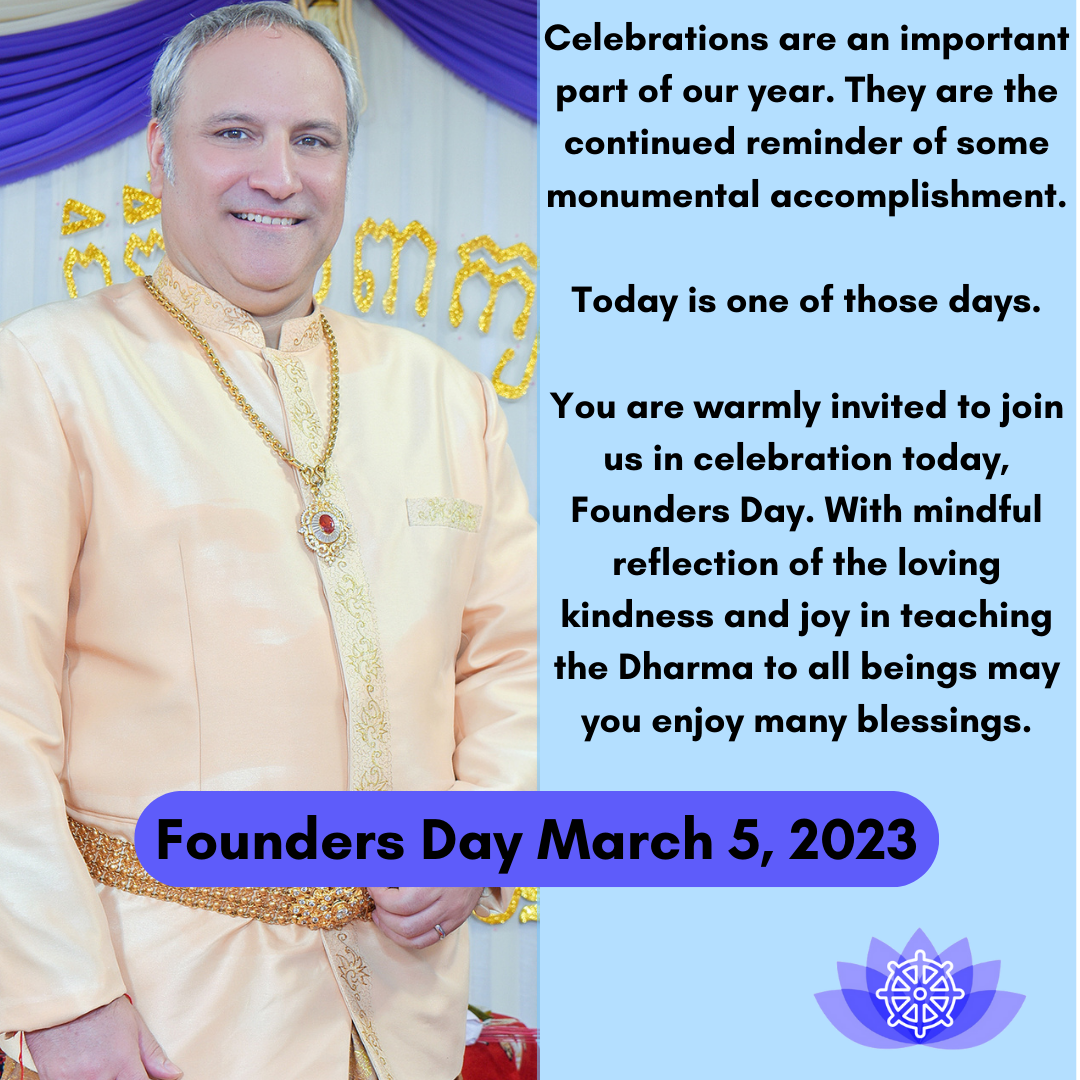
Founders Day Message 2023

Founders Day Message 2023

Celebrations are an important event in that they offer mindful recognition for a meaningful event or an important mile stone. 

Founders Day is a day where I renew my commitment to serving you and to those suffering. It is also a time of mindful reflection on all of the good Blue Lotus Meditation and Mindfulness Center has provided individuals, our community, and the world. Although our practitioners come from all over the world, varying occupations and ages, they all experience suffering. Through Buddhas teachings, we have helped ease the suffering of people coping with addiction, trauma, homelessness, anxiety, stress, relationships, and PTSD to name only a few. 

Our Founder
The work and support we offer is important and meaningful. 

And, most importantly, there is never a fee for any of our offerings.

How we serve others.

Each week we offer virtual sangha's for those that may have experienced trauma, LGBQT+ community, veterans, teens, and a general 'welcoming' sangha. All meetings are conducted via Skype and anonymity, if desired, is always maintained. 

We also offer several developmental classes, Resiliency+, for example. Being resilient is important to survival however when one only survives one misses the true beauty that is around us, even during those hard times.

Our Sutra Study is a weekly meeting where were explore one of the 84,000 Buddhist sutras, their meaning, and how they provide a necessary vehicle for beings to walk a noble path towards enlightenment.

In the summer we also offer a Teen Mindfulness camp. For one week teens from all communities are welcome to camp in our 'outdoor' meditation hall to disconnect from the harmful distractions of life so that they may learn the necessary mindfulness skills to help them navigate the challenges they will face in their adult life. 

Also on the last day of each month from May to September we offer Silent Retreats. Here practitioners from all ages and skill levels are invited to sit in silent contemplation, disconnect from their hectic lives so that they may reconnect to their being. A free vegetarian lunch is served as well. 

How are we able to provide our services at no cost?

Imagine a child or elderly person falling to the ground and in pain. Would you say 'I'll pick you up off the ground but only if you pay me'?

Of course not. You would assist them up, ask if they were OK, and comfort them as needed. 

We are compassionate towards all beings. We have empathy towards all beings. We know that all beings are suffering and we have the means to offer some relief of their suffering. So we do.

We are entirely donation based and warmly welcome all forms of generosity.

Our message?

Simply put, our message, my message, is the same as the Buddhas. It is one of hope. It is one of compassion. It is one of love for all living beings, including yourself.

Birthday Cake
So as you move about your day look at the stranger with welcoming eyes and a warm smile.

Make a donation to a local charity or animal shelter. 

Perhaps even embracing 'noble silence' when a stressful situation arises.

Being kind to those that need it is a wonderful way to share in the joy of this Founders day. 
   

Wishing you continued peace and wellbeing,


Vladimir


You are warmly invited to follow on us on Facebook and Instagram at @bluelotuscenter for more ways to improve your mindfulness practice and wellbeing.

Blue Lotus Meditation and Mindfulness Center is a registered 501(c)(3) religious organization.

Website and monthly newsletter: www.bluelotusmeditation.us

For guided meditations and Dharma talks, please visit and subscribe to our YouTube channel.

Facebook

Instagram


Thursday, February 23, 2023

Life, Liberation, And The Pursuit of Satisfaction

We've all been gifted life. It's not important 'how' we received this gift nor is it important from 'whom' we've received this gift. We have it now so what to do with it. Living, in the most basic sense, is easy, one only needs to wake up from sleep, find sustenance, and shelter, and you live. Cats do this. Birds do this. Worms do it too.

But these actions simply keep us alive, perhaps as humans we need, or at least, are capable of more.

In fact we are capable of more which is why we have the ability to experience the conditions of 'liberation', 'dissatisfaction' and 'satisfaction'. As people, most of us transition from dissatisfaction to satisfaction back to dissatisfaction continuously there are even fewer that experience liberation.

Let's start with a basic understanding of the terms life, satisfaction, dissatisfaction, and liberation.

Life isn't consciousness. It's not Rene Descartes "I think therefor I am". Life is the body's ability to maintain homeostasis day in and day out. All living beings do this, from humans all the way to the simplest single-celled organism.

Satisfaction and dissatisfactions is the condition of having a need or expectation met or not. 

Liberation is ending the cycle of samsara, the continued cycle of rebirth until Nirvana is achieved. And to get there emptiness, signlessness, and aimlessness are the doors that one may walk through. Or put another way emptiness is 'This is because of that'. Signlessness is that the form of an object changes but the 'object' is still there, like water evaporating to vapor, it's still 'water'. While aimlessness means you don’t put anything in front of you as the object of your pursuit.

Ok, liberation sounds like a lot to remember but in essence it's that nothing exists without being formed from the destruction of something else and what we see isn't all that it is.

Aimlessness is what we'll mostly focus on here since our society strives for the accumulation of 'things' and 'status'.

To put it plainly, you will not be satisfied once you achieve what you've set out to acquire or accumulate, at least for very long. Why is that? Because that's not what you're truly looking for. 

Others have placed the seed inside you that if you're a doctor, lawyer, professor, married, have a fast car, have a big home, travel around the world, and more...that you'll be happy. Society has watered that seed of dissatisfaction with certain ideas, concepts, and notions are necessary to achieve happiness. The Buddha teaches us that to understand we must see through these ideas, concepts, and notions. We let them go.

Some of you reading this probably have achieved some or most of these items. Are you happy? Or are you working on 'the next item'? That next item is not what you're looking for. 

Let's see if that's a true statement. 

Reflect on whare you are now, at this very moment.

This moment is exactly where you wanted to be yesterday and here you are. You should be happy and content but yet you're striving for more. And when you're striving for more you're living in a future that does not exist all the while forsaking today, the here and now. Because what you're seeking is not what you're looking for.

So, how do you pursue satisfaction?

You don't. 

Satisfaction is already within you. You only need to let the condition of dissatisfaction melt away so that satisfaction may be watered and bloom, just like emptiness and signlessness.


Let us know what you think in the comments below.


Wishing you continued peace and wellbeing,


Vladimir


You are warmly invited to follow on us on Facebook and Instagram at @bluelotuscenter for more ways to improve your mindfulness practice and wellbeing.

Blue Lotus Meditation and Mindfulness Center is a registered 501(c)(3) religious organization.

Website and monthly newsletter: www.bluelotusmeditation.us

For guided meditations and Dharma talks, please visit and subscribe to our YouTube channel.

Facebook

Instagram

Tuesday, January 3, 2023

Back To The Present: Living With Mindful Awareness Today

How often do you find yourself revisiting the past regardless of whether it was a good event or one of suffering? 'If I would have only...' statements are a common preamble to such reimaginations.

How often do you fast forward your life, waiting for the present moment to end for a time that you anticipate will be filled with ease and joy. 'When I earn my college degree my life will be easier', are common conclusory statements as well. 

Holding grudges is living in the past. Continually judging someone from an action they did many years ago is living in the past. Thinking and longing for the past, well...is living on the past. And living in the past robs us of the precious jewel we have today. 

Trying to read someone's thoughts or mindset is living on the future. Anticipation or dread is living in the future. Wishing that an experience is over is living in the future as well. It is living in the future in the sense that we are expecting that some future moment will be better than the present one you are currently in. 

Many of us, including myself, enjoy a good sci-fi time travel movie. They offer us a nostalgic view of when we were younger or perhaps of a future time when the problems of society have been eradicated. Yes, I'm still waiting patiently for either a hoverboard or flying car.

But imagine continuously judging every current situation under the lens of a distant past. A past that will never, under any circumstance, present itself again. Or imagine judging an old high school classmate, friend or otherwise, as they were from when they were only 16 or 17 years old? Are you still the same person from that age? Probably not. These examples are not two isolated circumstances, they are intrinsically intertwined. Mindset such as these limit us from experiencing the moment or person as it truly is. We are busy making the situation fit our narrative. We have allowed an idea, concept, or notion, to rob us of the present moment.

Conversely, when we try to 'figure out' what someone else is thinking our minds are consistently active in trying to stay one step ahead. In doing so our minds are playing out so many potential scenarios that most likely will never even manifest. For example, recall a hard conversation you were about to partake in. Did you explore several 'hypothetical' outcomes? How many paths did you walk down? 'If I say this' their response 'could be'. This is a fine example of living in the future and for what purpose? Did the conversation unfold as expected? How much time did you spend in preparation that could have been spent mindfully elsewhere? But more importantly we aren't listening to understand, we are listening to respond. Listening to respond is living in the future and results in a disservice to both parties.

Regardless of whether or not the sci-fi version of time travel isn't important to our daily lives, many of us are already living in the past or the future robbing us of the time we already exist in. We rob ourselves of the true joy of being with ourselves at the expense of a past that will never happen again or a future that will always be unpredictable.

So let's all get back to the present moment...no flux capacitor needed. 


Wishing you continued peace and wellbeing,


Vladimir


You are warmly invited to follow on us on Facebook and Instagram at @bluelotuscenter for more ways to improve your mindfulness practice and wellbeing.

Blue Lotus Meditation and Mindfulness Center is a registered 501(c)(3) religious organization.

Website and monthly newsletter: www.bluelotusmeditation.us

For guided meditations and Dharma talks, please visit and subscribe to our YouTube channel.

Facebook

Instagram 

AmazonSmile


Ancient wisdom. Practical guidance. A more mindful life.

Ancient wisdom. Practical guidance. A more mindful life. The teachings of the Buddha have offered guidance for understanding ourselves, meet...