Sunday, April 23, 2023

The Three Ages of Buddhism And The Return of Self-Liberation

Everything is impermanent and nothing may arise without the destruction or decay of something previous. This fundamental concept even holds true to Buddhism and the Buddhas teachings. During the fall of the Han Dynasty in the 3rd Century Buddhist history, or periods, were deduced and categorized into three ages. 

Buddha And Monks
The Three Ages of Buddhism, sometimes called The Three Ages of the Dharma are:

  • Age of the True Dharma
  • Age of the Counterfeit Dharma
  • Age of the Final Dharma


Age of the True Dharma

This Age began immediately after the Buddhas death and lasted between 500 or 1,000 years depending on the source material used. It was during this age when the teaching were still strong, individuals were capable of comprehending the meaning of the Dharma and thereby skillfully putting it into practice. As a result, many were able to attain enlightenment under their own power.

Age of the Counterfeit Dharma

During this Age the true teachings become obscured and only a semblance of the meaning exists. This Age lasts for 500 or 1,000 years depending on the sources used. However, what is notable during this Age is that only a few people of great intelligence are able to grasp the Dharma skillfully thus achieving enlightenment. Buddhism was well integrated into societies throughout Asia. The decline in individual enlightenment may be in part due to the formalization of the practices, resulting in fewer people achieving enlightenment.

Age of the Final Dharma

This is the current Age in which we are experiencing and by all historical sources will last for 10,000 years. During this Age people are easily tainted by the Three Poisons: greed, anger, and foolishness. As a result, people lose their own aspirations for achieving Buddhahood. We may witness the deteriorating condition of people's feeble capacities, the loss of the meaning of the Buddhas teachings, and the bombardment greed, anger, and trivialities of modern society.

This resulting loss of faith in traditional practices and teachings as means of gaining liberation has led to the popularization of new modes of practice that rely more on an already-enlightened Buddha or a series of texts for liberation.

How do we, as individuals, return to the path the Buddha revealed to us so we may obtain our own Buddhahood? 

Comforting Friends
We may start by remembering the purpose of Buddhism and the Buddhas teachings which simply are the Four Noble Truths and the cessation of suffering. We suffer because we have attachments. From there the Buddha gave us the Noble Eightfold Path which contain precise qualities and instructions on how to achieve liberation.

So how do we view or incorporate the many Buddhist scriptures, texts, and venerable leaders transmitting the Dharma today?

If you pick up a dictionary and look up a word you'll get a single definition. If you pick up another dictionary and look up the same word you'll find a slightly different definition. If you pick up a third dictionary and look up the word, again you'll find a slightly different definition. Each dictionary offers the same intention or meaning of the term but is simply presented in a different way. 

The same holds true to the tens of thousands of Buddhist sutras, texts, and the many Dharma teachers and leaders. There is not a 'right' or 'wrong' way to transmit the Dharma as long as the Buddhas intent is not lost, the cessation of suffering.

When our words are kind and supporting instead of harsh or vulgar, when our actions are non-violent and unifying, instead of warring and divisive, when our thoughts are nurturing and beneficial instead of destructive and self-glamourizing, we are on our way to our own liberation.


Wishing you continued peace and wellbeing,


Vladimir


You are warmly invited to follow on us on Facebook and Instagram at @bluelotuscenter for more ways to improve your mindfulness practice and wellbeing.

Blue Lotus Meditation and Mindfulness Center is a registered 501(c)(3) religious organization.

Website and monthly newsletter: www.bluelotusmeditation.us

For guided meditations and Dharma talks, please visit and subscribe to our YouTube channel.

Facebook

Instagram

Thursday, April 13, 2023

Songkran 2023

This year I had the wonderful opportunity to celebrate Songkran at Wat Buddhavas in Houston, Tx. with my mother, her husband, my wife, and my daughter. Songkran is the Thai New Year although it is also celebrated throughout Southeast Asia in countries such as Cambodia, Viet Nam, and Laos. 

The term Songkran is a Sanskrit word meaning 'to move' or 'movement' and marks the solar New Year and is celebrated over a period of three days. Celebrations during this time involve making merit with visiting temples or pagodas and making offerings to the monks. Songkran is also known for its 'water festival' where people pour water over statues of the Buddha as well as over the hands of the monks and elderly. This water pouring represents purification and the washing away of bad luck. Streets are often closed and people enjoy playful water fights and sometimes also throw a white powder at each other too.

Wat Buddhavas is a beautiful Wat and has 8 monks including the Abbot. When I arrived Saturday night after driving down from Minneapolis most of the activities were concluding but there was still much going on. People were eating the various types of street food such as noodle soup, fried bananas, stick rice, and grilled meats. What was really nice was to see the level of involvement of young people. Too often I find that when immigrants come to the US their children loose so much of what their culture offers simply so they may 'fit in' here. To see otherwise here was certainly a nice reprise.

The next day, Sunday, we arrived at the temple around 9:30 AM. My mothers husband, Yutana, is a former monk and leads or emcees the various events such as Songkran. At 10:30 we all sat in the temple where we enjoyed the monks chanting and the alms-giving ceremony. It was during this event that I was walking behind the monks as they collected their offerings from the lay people in attendance. Offerings consist of rice, foods, and money which after collected are sorted and counted all in support of Wat.

From 11 - 12 PM the monks and the lay people enjoyed lunch together. It is customary that lay people cook food and offer it to the monks. What's leftover, and it's always a lot, is shared joyfully with all in attendance. At 1 PM we all gathered back in the temple to listen to a sermon about the meaning of Songkran and to receive the blessings from the monks. Lastly, at 2 PM we all walked around the temple three times in celebration of Songkran and then bathed the Buddha, monks, and elders.

Holidays, no matter the origination, are an important part of ones culture. They carry meaning and significance that are necessary to maintaining cultural identity, cultural connections, and family connections especially when one is far away from the country of origin. Festivals such as Songkran are open to the public and allow for those outside of the particular community to learn more about them. Learning about other cultures, instead of shying away from them as something 'foreign', builds understanding which sometimes seems to be in short supply.

It is when we understand one another that unity and peace are able to be cultivated and fostered.


Happy Songkran 2023 my dear friends.


Wishing you continued peace and wellbeing,


Vladimir


You are warmly invited to follow on us on Facebook and Instagram at @bluelotuscenter for more ways to improve your mindfulness practice and wellbeing.

Blue Lotus Meditation and Mindfulness Center is a registered 501(c)(3) religious organization.

Website and monthly newsletter: www.bluelotusmeditation.us

For guided meditations and Dharma talks, please visit and subscribe to our YouTube channel.

Facebook

Instagram

Monday, April 3, 2023

The Dharma As A Career Guide

Where to go after high school? 

Should I go to university, join the military, or get a regular job?

What career path should I choose?

What if my career choice doesn't go as planned?

Career Choices

There are questions many of our older teens and some adults face when a change is upon them. Uncertainty often waters fear, anxiety, and self-doubt. These are examples of suffering.

But suppose there were some guidance to help support a positive, nurturing decision that will certainly have an impact on your life...as well as the lives of others.

When we look at the Eightfold Path in its entirety, we see that it offers us a way to live a wholesome life in general and this is a wonderful realization. 

But most of us need to have an income, a way to support ourselves and perhaps others if we have a family is a necessity, so we are fortunate that the Buddha has given us this guidance.

Right Livelihood is the fifth component of the Noble Eightfold Path and is part of the division of 'Ethical Conduct' along with Right Speech and Right Action. This is an obvious arrangement being that whatever career you decide upon needs to be uplifting for yourself and others. We should also note that your choice, by default, will not violate the Five Precepts: 

  • abstaining from killing living beings, 
  • stealing, 
  • sexual misconduct, 
  • lying, and 
  • refraining from intoxicating substances

If we were to construct a definition of Right Livelihood inclusive of the Five Precepts our career choice is one that is uplifting, increases happiness, develops wisdom, and nurtures well-being, all the while easing the suffering in world. 

The Buddha does not tell us you should do this job and you do that job. He lets us know that whatever career we decide upon, as long as it aligns with Right Livelihood, it's not a wrong choice. 

But what I think many overlook, even with today’s mindset, is that no one is forced to stay in one particular career for their entire working life. On the contrary, we are told that everything is impermanent, and this includes a career decision we made for ourselves years ago. People stay, often unsatisfied, in a career because of attachment. People become comfortable with routine, even if it's toxic to their well-being.  

Fork On Your Path

Mindsets that reinforce this attachment sound like 'I'm too old to start over', 'I have bills to pay', 'I'm the only one who knows what to do there'. If you are watering these types of statements to yourself, justifying why you remain where you're not growing, you are not nurturing your well-being thereby not easing suffering. It may be time for a healthy change. 

It's important to understand one does not need a high level of education or a fancy job title to ease suffering in our world or for personal satisfaction. One simply needs to remember that satisfaction and joy are elicited when we let go of the attachments of living in the past or future (I shoulda's and I coulda's), bring mindful awareness to our present moment, and serve others with compassion. This is opening your Dharma Heart. 

Remember, a career is simply a way for one to sustain bodily needs and that may be accomplished in almost any career. But to walk the Noble Eightfold Path, earn merit, and to ease suffering requires one to have discipline, empathy and compassion for all living beings. This is your Noble Journey and no one else’s. 

How you go about this is entirely up to you, and that’s the beauty of impermanence, choice, and wide path of Right Livelihood. No one can or should ever tell you that you need to follow an exact career path to achieve satisfaction.


Wishing you continued peace and wellbeing,


Vladimir


You are warmly invited to follow on us on Facebook and Instagram at @bluelotuscenter for more ways to improve your mindfulness practice and wellbeing.

Blue Lotus Meditation and Mindfulness Center is a registered 501(c)(3) religious organization.

Website and monthly newsletter: www.bluelotusmeditation.us

For guided meditations and Dharma talks, please visit and subscribe to our YouTube channel.

Facebook

Instagram

Thursday, March 23, 2023

Coming Into And Nurturing Wisdom

When it comes to wisdom one of the first thoughts that comes to mind is an old man with a long beard. Or perhaps a grandparent or other revered elderly person who has a lot of life experiences. We often associate age and experience with wisdom. But from a practical viewpoint we know that isn’t always true.


So, what is wisdom?


In Buddhism wisdom is seeing that all phenomena are incomplete, impermanent, and not-self. This understanding is totally freeing and leads to the security and happiness called Nirvana.


But what did Buddha have to say about this level or type of wisdom? 


Surprisingly, the Buddha doesn't speak too much about this level of wisdom. That is because it’s not wisdom if we simply believe what we are told. Instead, he spoke more of wisdom in the common understanding. 


Thinking Woman
True wisdom is to directly see and understand for ourselves. It relies on the non-judgmental understanding of an event or circumstance. Rather than being closed-minded, wisdom keeps an open mind. Wisdom listens to others points of view with openness rather than being bigoted. Wisdom carefully examines the facts that contradict beliefs we may hold, rather than keeping dust in our eyes. Wisdom is objective rather than prejudiced. Wisdom takes its time to form opinions instead of simply accepting the first or most emotional response that is offered. And just as important wisdom is always ready to change beliefs when facts that contradict them are presented.
 
A person who embodies these qualities is certainly wise and is certain to eventually arrive at true understanding. Whereas on the contrary, the path of just believing what you are told is easy.
 
Your path in essence requires courage, patience, flexibility, and intelligence.

With these qualities well established, how then do we come into wisdom?

Fortunately the Buddha has transmitted to us the Noble Eightfold Path of which Right Understanding and Right Thought directly related to wisdom Right Understanding is a true understanding of how reality and suffering are intertwined. And Right Thought directs us to turn away from the vicious cycle of craving and desire by committing to a lifestyle of self-improvement and ethical conduct.


How Do We Nurture Wisdom?


Courage is not only not being afraid to ask questions, or asking others for help, or even allowing help from others, although these are certainly vital. Courage is also having the strength to truly examine our current beliefs with openness and objectivity.


Patience being another quality is simply ‘letting the situation grow’. We can not rush a desired outcome no matter how hard we push or try.


Flexibility is the ability to be non-dogmatic in our way of doing things and being open to change. This can certainly be hard for someone once a comfortable routine has been established.


Intelligence isn't necessarily how 'smart' you are. Solving quadratic equations isn't a part of most peoples lives. One of the most important aspects of intelligence is realizing when something isn’t working. Although each situation is different, this is where patience comes in, we do need to accept when a certain course of action needs to stop. Realizing when something needs to change or has outgrown its usefulness, and not just doing it because that what you've always done, is certainly an important aspect of intelligence.


The Buddha in his infinite compassion and wisdom as revealed to us a path in which we too may achieve liberation. This path is the Noble Eightfold Path which provides us valuable lessons and insight that just as relevant in modern times as it was 2,500 years ago.


Wishing you continued peace and wellbeing,


Vladimir


You are warmly invited to follow on us on Facebook and Instagram at @bluelotuscenter for more ways to improve your mindfulness practice and wellbeing.

Blue Lotus Meditation and Mindfulness Center is a registered 501(c)(3) religious organization.

Website and monthly newsletter: www.bluelotusmeditation.us

For guided meditations and Dharma talks, please visit and subscribe to our YouTube channel.

Facebook

Instagram


Monday, March 13, 2023

The Walking Meditation - Reflecting On Our Most Basic Needs

We often hear how much the world has changed in the past 10, 15, 20, 25, or 30 years or more depending on whom you speak with.

That viewpoint has never made much sense to me, even as a child. And as an adult now with more experience, I still maintain that view. We still face the same stress and anxiety today that our parents, grandparents, great grandparents, and so on did. True, technology may have changed during that time, but the stress, anxiety, and basic responses are the same.

We each need to eat and drink each day. We need to provide shelter for ourselves and perhaps a family. We all need to have some form of clothing to protect us from the weather. We all need to feel the sense of security and safety a community provides. Having these basic needs met in well balanced proportion allows each of us to reduce or minimize our stress.

A person feeling stress
But what happens when we do not have or at least perceive to not have these needs met? Humans, as an evolutionary response, tend to envision the worst-case scenario which elevates our stress and anxiety levels. 'I have no food or water; how will I survive the next few days?' This may have been a beneficial response thousands of years ago but how does it serve us now? In short, it won’t.

So when our access to the most basic needs seems to have been interrupted how do we proceed and return to balance?

This is where the effective walking meditation may be used. But to use this form of meditation effectively one has to realize the need and benefits of this non-action or non-doing. When times of stress or anxiety arise, it's time for walking meditation.

When we become skillful with our awareness of the present moment walking meditation allows us to negate the immediate 'fight or flight' response. As a result, we institute mindful reflection of our circumstance with questions such as: is this situation as dire as it seems? Have I encountered a situation like this before? I made it through then and I'll make it through now.

Walking meditation may be enjoyed anywhere, not just in a peaceful park, garden, or forest. Places like a city block, your office building, or even shopping mall or grocery store are just as ideal. The important aspect of the walking meditation is bringing awareness to your surroundings. With each slow step breathing in and out with kind attention to any sensation in your nostrils such as the coolness of the air during your in-breath and the warmth during your out-breath.

Knowing that in that very moment you have everything you need, nothing more and nothing less.

If you are enjoying your walking meditation in a office look at the carpet or walls every so often. Do you see any imperfections like a snag in the carpet or peeling paint in a corner? How often have you walked by there without ever even noticing? There will always be some form of imperfection but the carpet still functions as required preventing people from slipping as they walk. The wall still stands and provides support for the building and perhaps even has some beautiful artwork hanging.

Office Hallway
What smells are you able to notice as you continue your walk? Is it during lunchtime? Without judgmental statements like ‘this smells good’ or ‘eww, what’s that smell’ see if you’re able to discern the varying fragrances. Remember, people like all kinds of foods and it’s not for us to decide what someone else should like or dislike.

Walking meditation allows us to reconnect with what’s most precious, life. We are alive in that present moment and that is a gift in itself. The past is gone, and we may never return there. The future does not exist as we conceptualize it to be. And therefore, the ‘troubles’ we face, no matter how severe we may initially think, truly aren’t as severe as we give them credit for.


Wishing you continued peace and wellbeing,


Vladimir


You are warmly invited to follow on us on Facebook and Instagram at @bluelotuscenter for more ways to improve your mindfulness practice and wellbeing.

Blue Lotus Meditation and Mindfulness Center is a registered 501(c)(3) religious organization.

Website and monthly newsletter: www.bluelotusmeditation.us

For guided meditations and Dharma talks, please visit and subscribe to our YouTube channel.

Facebook

Instagram


Friday, March 3, 2023

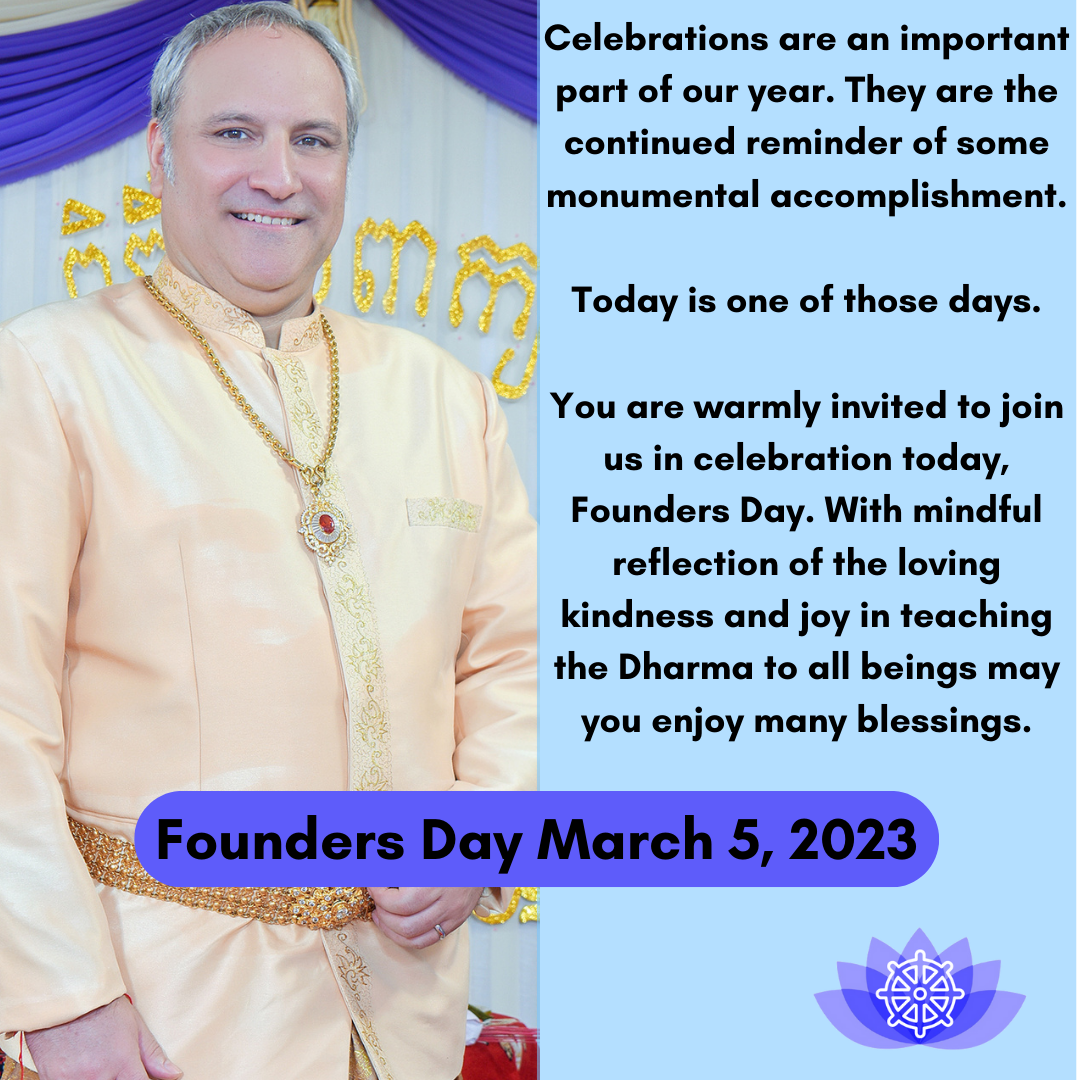
Founders Day Message 2023

Founders Day Message 2023

Celebrations are an important event in that they offer mindful recognition for a meaningful event or an important mile stone. 

Founders Day is a day where I renew my commitment to serving you and to those suffering. It is also a time of mindful reflection on all of the good Blue Lotus Meditation and Mindfulness Center has provided individuals, our community, and the world. Although our practitioners come from all over the world, varying occupations and ages, they all experience suffering. Through Buddhas teachings, we have helped ease the suffering of people coping with addiction, trauma, homelessness, anxiety, stress, relationships, and PTSD to name only a few. 

Our Founder
The work and support we offer is important and meaningful. 

And, most importantly, there is never a fee for any of our offerings.

How we serve others.

Each week we offer virtual sangha's for those that may have experienced trauma, LGBQT+ community, veterans, teens, and a general 'welcoming' sangha. All meetings are conducted via Skype and anonymity, if desired, is always maintained. 

We also offer several developmental classes, Resiliency+, for example. Being resilient is important to survival however when one only survives one misses the true beauty that is around us, even during those hard times.

Our Sutra Study is a weekly meeting where were explore one of the 84,000 Buddhist sutras, their meaning, and how they provide a necessary vehicle for beings to walk a noble path towards enlightenment.

In the summer we also offer a Teen Mindfulness camp. For one week teens from all communities are welcome to camp in our 'outdoor' meditation hall to disconnect from the harmful distractions of life so that they may learn the necessary mindfulness skills to help them navigate the challenges they will face in their adult life. 

Also on the last day of each month from May to September we offer Silent Retreats. Here practitioners from all ages and skill levels are invited to sit in silent contemplation, disconnect from their hectic lives so that they may reconnect to their being. A free vegetarian lunch is served as well. 

How are we able to provide our services at no cost?

Imagine a child or elderly person falling to the ground and in pain. Would you say 'I'll pick you up off the ground but only if you pay me'?

Of course not. You would assist them up, ask if they were OK, and comfort them as needed. 

We are compassionate towards all beings. We have empathy towards all beings. We know that all beings are suffering and we have the means to offer some relief of their suffering. So we do.

We are entirely donation based and warmly welcome all forms of generosity.

Our message?

Simply put, our message, my message, is the same as the Buddhas. It is one of hope. It is one of compassion. It is one of love for all living beings, including yourself.

Birthday Cake
So as you move about your day look at the stranger with welcoming eyes and a warm smile.

Make a donation to a local charity or animal shelter. 

Perhaps even embracing 'noble silence' when a stressful situation arises.

Being kind to those that need it is a wonderful way to share in the joy of this Founders day. 
   

Wishing you continued peace and wellbeing,


Vladimir


You are warmly invited to follow on us on Facebook and Instagram at @bluelotuscenter for more ways to improve your mindfulness practice and wellbeing.

Blue Lotus Meditation and Mindfulness Center is a registered 501(c)(3) religious organization.

Website and monthly newsletter: www.bluelotusmeditation.us

For guided meditations and Dharma talks, please visit and subscribe to our YouTube channel.

Facebook

Instagram


Thursday, February 23, 2023

Life, Liberation, And The Pursuit of Satisfaction

We've all been gifted life. It's not important 'how' we received this gift nor is it important from 'whom' we've received this gift. We have it now so what to do with it. Living, in the most basic sense, is easy, one only needs to wake up from sleep, find sustenance, and shelter, and you live. Cats do this. Birds do this. Worms do it too.

But these actions simply keep us alive, perhaps as humans we need, or at least, are capable of more.

In fact we are capable of more which is why we have the ability to experience the conditions of 'liberation', 'dissatisfaction' and 'satisfaction'. As people, most of us transition from dissatisfaction to satisfaction back to dissatisfaction continuously there are even fewer that experience liberation.

Let's start with a basic understanding of the terms life, satisfaction, dissatisfaction, and liberation.

Life isn't consciousness. It's not Rene Descartes "I think therefor I am". Life is the body's ability to maintain homeostasis day in and day out. All living beings do this, from humans all the way to the simplest single-celled organism.

Satisfaction and dissatisfactions is the condition of having a need or expectation met or not. 

Liberation is ending the cycle of samsara, the continued cycle of rebirth until Nirvana is achieved. And to get there emptiness, signlessness, and aimlessness are the doors that one may walk through. Or put another way emptiness is 'This is because of that'. Signlessness is that the form of an object changes but the 'object' is still there, like water evaporating to vapor, it's still 'water'. While aimlessness means you don’t put anything in front of you as the object of your pursuit.

Ok, liberation sounds like a lot to remember but in essence it's that nothing exists without being formed from the destruction of something else and what we see isn't all that it is.

Aimlessness is what we'll mostly focus on here since our society strives for the accumulation of 'things' and 'status'.

To put it plainly, you will not be satisfied once you achieve what you've set out to acquire or accumulate, at least for very long. Why is that? Because that's not what you're truly looking for. 

Others have placed the seed inside you that if you're a doctor, lawyer, professor, married, have a fast car, have a big home, travel around the world, and more...that you'll be happy. Society has watered that seed of dissatisfaction with certain ideas, concepts, and notions are necessary to achieve happiness. The Buddha teaches us that to understand we must see through these ideas, concepts, and notions. We let them go.

Some of you reading this probably have achieved some or most of these items. Are you happy? Or are you working on 'the next item'? That next item is not what you're looking for. 

Let's see if that's a true statement. 

Reflect on whare you are now, at this very moment.

This moment is exactly where you wanted to be yesterday and here you are. You should be happy and content but yet you're striving for more. And when you're striving for more you're living in a future that does not exist all the while forsaking today, the here and now. Because what you're seeking is not what you're looking for.

So, how do you pursue satisfaction?

You don't. 

Satisfaction is already within you. You only need to let the condition of dissatisfaction melt away so that satisfaction may be watered and bloom, just like emptiness and signlessness.


Let us know what you think in the comments below.


Wishing you continued peace and wellbeing,


Vladimir


You are warmly invited to follow on us on Facebook and Instagram at @bluelotuscenter for more ways to improve your mindfulness practice and wellbeing.

Blue Lotus Meditation and Mindfulness Center is a registered 501(c)(3) religious organization.

Website and monthly newsletter: www.bluelotusmeditation.us

For guided meditations and Dharma talks, please visit and subscribe to our YouTube channel.

Facebook

Instagram

The Sixteen Imperfections of the Mind | The Eight Imperfections : Part 2 Subtle Distortions of Identity

As we continue, the first eight imperfections are loud and easy to recognize. The second eight are quieter. They hide behind respectability ...