Thursday, March 23, 2023

Coming Into And Nurturing Wisdom

When it comes to wisdom one of the first thoughts that comes to mind is an old man with a long beard. Or perhaps a grandparent or other revered elderly person who has a lot of life experiences. We often associate age and experience with wisdom. But from a practical viewpoint we know that isn’t always true.


So, what is wisdom?


In Buddhism wisdom is seeing that all phenomena are incomplete, impermanent, and not-self. This understanding is totally freeing and leads to the security and happiness called Nirvana.


But what did Buddha have to say about this level or type of wisdom? 


Surprisingly, the Buddha doesn't speak too much about this level of wisdom. That is because it’s not wisdom if we simply believe what we are told. Instead, he spoke more of wisdom in the common understanding. 


Thinking Woman
True wisdom is to directly see and understand for ourselves. It relies on the non-judgmental understanding of an event or circumstance. Rather than being closed-minded, wisdom keeps an open mind. Wisdom listens to others points of view with openness rather than being bigoted. Wisdom carefully examines the facts that contradict beliefs we may hold, rather than keeping dust in our eyes. Wisdom is objective rather than prejudiced. Wisdom takes its time to form opinions instead of simply accepting the first or most emotional response that is offered. And just as important wisdom is always ready to change beliefs when facts that contradict them are presented.
 
A person who embodies these qualities is certainly wise and is certain to eventually arrive at true understanding. Whereas on the contrary, the path of just believing what you are told is easy.
 
Your path in essence requires courage, patience, flexibility, and intelligence.

With these qualities well established, how then do we come into wisdom?

Fortunately the Buddha has transmitted to us the Noble Eightfold Path of which Right Understanding and Right Thought directly related to wisdom Right Understanding is a true understanding of how reality and suffering are intertwined. And Right Thought directs us to turn away from the vicious cycle of craving and desire by committing to a lifestyle of self-improvement and ethical conduct.


How Do We Nurture Wisdom?


Courage is not only not being afraid to ask questions, or asking others for help, or even allowing help from others, although these are certainly vital. Courage is also having the strength to truly examine our current beliefs with openness and objectivity.


Patience being another quality is simply ‘letting the situation grow’. We can not rush a desired outcome no matter how hard we push or try.


Flexibility is the ability to be non-dogmatic in our way of doing things and being open to change. This can certainly be hard for someone once a comfortable routine has been established.


Intelligence isn't necessarily how 'smart' you are. Solving quadratic equations isn't a part of most peoples lives. One of the most important aspects of intelligence is realizing when something isn’t working. Although each situation is different, this is where patience comes in, we do need to accept when a certain course of action needs to stop. Realizing when something needs to change or has outgrown its usefulness, and not just doing it because that what you've always done, is certainly an important aspect of intelligence.


The Buddha in his infinite compassion and wisdom as revealed to us a path in which we too may achieve liberation. This path is the Noble Eightfold Path which provides us valuable lessons and insight that just as relevant in modern times as it was 2,500 years ago.


Wishing you continued peace and wellbeing,


Vladimir


You are warmly invited to follow on us on Facebook and Instagram at @bluelotuscenter for more ways to improve your mindfulness practice and wellbeing.

Blue Lotus Meditation and Mindfulness Center is a registered 501(c)(3) religious organization.

Website and monthly newsletter: www.bluelotusmeditation.us

For guided meditations and Dharma talks, please visit and subscribe to our YouTube channel.

Facebook

Instagram


Monday, March 13, 2023

The Walking Meditation - Reflecting On Our Most Basic Needs

We often hear how much the world has changed in the past 10, 15, 20, 25, or 30 years or more depending on whom you speak with.

That viewpoint has never made much sense to me, even as a child. And as an adult now with more experience, I still maintain that view. We still face the same stress and anxiety today that our parents, grandparents, great grandparents, and so on did. True, technology may have changed during that time, but the stress, anxiety, and basic responses are the same.

We each need to eat and drink each day. We need to provide shelter for ourselves and perhaps a family. We all need to have some form of clothing to protect us from the weather. We all need to feel the sense of security and safety a community provides. Having these basic needs met in well balanced proportion allows each of us to reduce or minimize our stress.

A person feeling stress
But what happens when we do not have or at least perceive to not have these needs met? Humans, as an evolutionary response, tend to envision the worst-case scenario which elevates our stress and anxiety levels. 'I have no food or water; how will I survive the next few days?' This may have been a beneficial response thousands of years ago but how does it serve us now? In short, it won’t.

So when our access to the most basic needs seems to have been interrupted how do we proceed and return to balance?

This is where the effective walking meditation may be used. But to use this form of meditation effectively one has to realize the need and benefits of this non-action or non-doing. When times of stress or anxiety arise, it's time for walking meditation.

When we become skillful with our awareness of the present moment walking meditation allows us to negate the immediate 'fight or flight' response. As a result, we institute mindful reflection of our circumstance with questions such as: is this situation as dire as it seems? Have I encountered a situation like this before? I made it through then and I'll make it through now.

Walking meditation may be enjoyed anywhere, not just in a peaceful park, garden, or forest. Places like a city block, your office building, or even shopping mall or grocery store are just as ideal. The important aspect of the walking meditation is bringing awareness to your surroundings. With each slow step breathing in and out with kind attention to any sensation in your nostrils such as the coolness of the air during your in-breath and the warmth during your out-breath.

Knowing that in that very moment you have everything you need, nothing more and nothing less.

If you are enjoying your walking meditation in a office look at the carpet or walls every so often. Do you see any imperfections like a snag in the carpet or peeling paint in a corner? How often have you walked by there without ever even noticing? There will always be some form of imperfection but the carpet still functions as required preventing people from slipping as they walk. The wall still stands and provides support for the building and perhaps even has some beautiful artwork hanging.

Office Hallway
What smells are you able to notice as you continue your walk? Is it during lunchtime? Without judgmental statements like ‘this smells good’ or ‘eww, what’s that smell’ see if you’re able to discern the varying fragrances. Remember, people like all kinds of foods and it’s not for us to decide what someone else should like or dislike.

Walking meditation allows us to reconnect with what’s most precious, life. We are alive in that present moment and that is a gift in itself. The past is gone, and we may never return there. The future does not exist as we conceptualize it to be. And therefore, the ‘troubles’ we face, no matter how severe we may initially think, truly aren’t as severe as we give them credit for.


Wishing you continued peace and wellbeing,


Vladimir


You are warmly invited to follow on us on Facebook and Instagram at @bluelotuscenter for more ways to improve your mindfulness practice and wellbeing.

Blue Lotus Meditation and Mindfulness Center is a registered 501(c)(3) religious organization.

Website and monthly newsletter: www.bluelotusmeditation.us

For guided meditations and Dharma talks, please visit and subscribe to our YouTube channel.

Facebook

Instagram


Friday, March 3, 2023

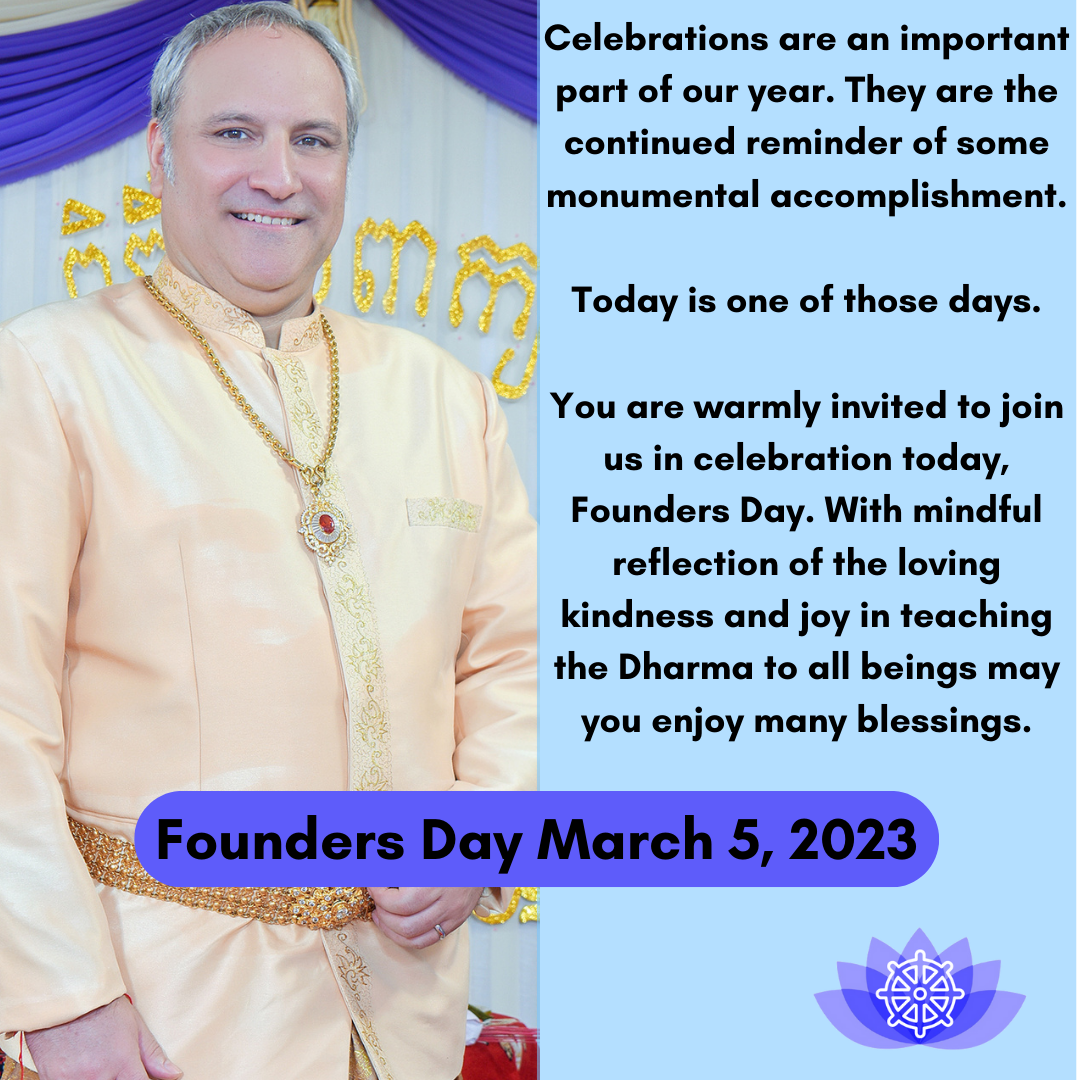
Founders Day Message 2023

Founders Day Message 2023

Celebrations are an important event in that they offer mindful recognition for a meaningful event or an important mile stone. 

Founders Day is a day where I renew my commitment to serving you and to those suffering. It is also a time of mindful reflection on all of the good Blue Lotus Meditation and Mindfulness Center has provided individuals, our community, and the world. Although our practitioners come from all over the world, varying occupations and ages, they all experience suffering. Through Buddhas teachings, we have helped ease the suffering of people coping with addiction, trauma, homelessness, anxiety, stress, relationships, and PTSD to name only a few. 

Our Founder
The work and support we offer is important and meaningful. 

And, most importantly, there is never a fee for any of our offerings.

How we serve others.

Each week we offer virtual sangha's for those that may have experienced trauma, LGBQT+ community, veterans, teens, and a general 'welcoming' sangha. All meetings are conducted via Skype and anonymity, if desired, is always maintained. 

We also offer several developmental classes, Resiliency+, for example. Being resilient is important to survival however when one only survives one misses the true beauty that is around us, even during those hard times.

Our Sutra Study is a weekly meeting where were explore one of the 84,000 Buddhist sutras, their meaning, and how they provide a necessary vehicle for beings to walk a noble path towards enlightenment.

In the summer we also offer a Teen Mindfulness camp. For one week teens from all communities are welcome to camp in our 'outdoor' meditation hall to disconnect from the harmful distractions of life so that they may learn the necessary mindfulness skills to help them navigate the challenges they will face in their adult life. 

Also on the last day of each month from May to September we offer Silent Retreats. Here practitioners from all ages and skill levels are invited to sit in silent contemplation, disconnect from their hectic lives so that they may reconnect to their being. A free vegetarian lunch is served as well. 

How are we able to provide our services at no cost?

Imagine a child or elderly person falling to the ground and in pain. Would you say 'I'll pick you up off the ground but only if you pay me'?

Of course not. You would assist them up, ask if they were OK, and comfort them as needed. 

We are compassionate towards all beings. We have empathy towards all beings. We know that all beings are suffering and we have the means to offer some relief of their suffering. So we do.

We are entirely donation based and warmly welcome all forms of generosity.

Our message?

Simply put, our message, my message, is the same as the Buddhas. It is one of hope. It is one of compassion. It is one of love for all living beings, including yourself.

Birthday Cake
So as you move about your day look at the stranger with welcoming eyes and a warm smile.

Make a donation to a local charity or animal shelter. 

Perhaps even embracing 'noble silence' when a stressful situation arises.

Being kind to those that need it is a wonderful way to share in the joy of this Founders day. 
   

Wishing you continued peace and wellbeing,


Vladimir


You are warmly invited to follow on us on Facebook and Instagram at @bluelotuscenter for more ways to improve your mindfulness practice and wellbeing.

Blue Lotus Meditation and Mindfulness Center is a registered 501(c)(3) religious organization.

Website and monthly newsletter: www.bluelotusmeditation.us

For guided meditations and Dharma talks, please visit and subscribe to our YouTube channel.

Facebook

Instagram


Thursday, February 23, 2023

Life, Liberation, And The Pursuit of Satisfaction

We've all been gifted life. It's not important 'how' we received this gift nor is it important from 'whom' we've received this gift. We have it now so what to do with it. Living, in the most basic sense, is easy, one only needs to wake up from sleep, find sustenance, and shelter, and you live. Cats do this. Birds do this. Worms do it too.

But these actions simply keep us alive, perhaps as humans we need, or at least, are capable of more.

In fact we are capable of more which is why we have the ability to experience the conditions of 'liberation', 'dissatisfaction' and 'satisfaction'. As people, most of us transition from dissatisfaction to satisfaction back to dissatisfaction continuously there are even fewer that experience liberation.

Let's start with a basic understanding of the terms life, satisfaction, dissatisfaction, and liberation.

Life isn't consciousness. It's not Rene Descartes "I think therefor I am". Life is the body's ability to maintain homeostasis day in and day out. All living beings do this, from humans all the way to the simplest single-celled organism.

Satisfaction and dissatisfactions is the condition of having a need or expectation met or not. 

Liberation is ending the cycle of samsara, the continued cycle of rebirth until Nirvana is achieved. And to get there emptiness, signlessness, and aimlessness are the doors that one may walk through. Or put another way emptiness is 'This is because of that'. Signlessness is that the form of an object changes but the 'object' is still there, like water evaporating to vapor, it's still 'water'. While aimlessness means you don’t put anything in front of you as the object of your pursuit.

Ok, liberation sounds like a lot to remember but in essence it's that nothing exists without being formed from the destruction of something else and what we see isn't all that it is.

Aimlessness is what we'll mostly focus on here since our society strives for the accumulation of 'things' and 'status'.

To put it plainly, you will not be satisfied once you achieve what you've set out to acquire or accumulate, at least for very long. Why is that? Because that's not what you're truly looking for. 

Others have placed the seed inside you that if you're a doctor, lawyer, professor, married, have a fast car, have a big home, travel around the world, and more...that you'll be happy. Society has watered that seed of dissatisfaction with certain ideas, concepts, and notions are necessary to achieve happiness. The Buddha teaches us that to understand we must see through these ideas, concepts, and notions. We let them go.

Some of you reading this probably have achieved some or most of these items. Are you happy? Or are you working on 'the next item'? That next item is not what you're looking for. 

Let's see if that's a true statement. 

Reflect on whare you are now, at this very moment.

This moment is exactly where you wanted to be yesterday and here you are. You should be happy and content but yet you're striving for more. And when you're striving for more you're living in a future that does not exist all the while forsaking today, the here and now. Because what you're seeking is not what you're looking for.

So, how do you pursue satisfaction?

You don't. 

Satisfaction is already within you. You only need to let the condition of dissatisfaction melt away so that satisfaction may be watered and bloom, just like emptiness and signlessness.


Let us know what you think in the comments below.


Wishing you continued peace and wellbeing,


Vladimir


You are warmly invited to follow on us on Facebook and Instagram at @bluelotuscenter for more ways to improve your mindfulness practice and wellbeing.

Blue Lotus Meditation and Mindfulness Center is a registered 501(c)(3) religious organization.

Website and monthly newsletter: www.bluelotusmeditation.us

For guided meditations and Dharma talks, please visit and subscribe to our YouTube channel.
Facebook

Instagram

Monday, February 13, 2023

Mindfulness And Civil Conversations

How often do we see public figures speaking unkindly towards another person or group of people?

This results in suffering for all. 

Microphone

How often do we see videos where someone is verbally attacking another person?

This too, results in suffering for all.

It seems it’s easy to speak harshly towards another when we view them as less than we are. Maybe they’re African, Asian, Hispanic, Caucasian, Christian, Muslim, atheist, gay, straight, transgendered, conservative, liberal, or socialist. All you know is that they are not ‘you’ and you feel that justifies harsh speech.

Maybe someone made a mistake on your food order. Maybe your package arrived late and damaged. Maybe you had to wait in line too long for a service in your opinion. Perhaps you’re displeased with a grade on an assignment and your teacher is firm in their scoring.

It may even seem justifiable to express yourself harshly when your expectations are not met to your satisfactions. But it’s not. In fact, there never is an appropriate time to speak harsh words towards anyone, ever.

Civility in speech, behavior, and thought is vital to nurturing your wellbeing.

Let’s consider a viral video example: recall a video where you saw a woman speak harshly to someone over a parking space, or a food delivery, or any number of instances. We see the woman loud, perhaps even using profanity, and her hands and arms flailing during this instance. The recipient of her behavior, depending on the location and their position, may be doing their best to remain composed and trying to deescalate the situation. All during this experience someone is filming while others are exposed to harshness.

No one in this situation is experiencing a nurturing environment. The woman is now referred to as a Karen. This perpetuates her suffering. And all others, no matter their level of involvement, experienced a perpetuation of their suffering. 

Angry man

People who watch the video experience suffering. How? When you laugh at someone’s suffering you are harming your own wellbeing. You are watering the seeds of heartlessness. That is suffering even though you may not realize it.

Now consider, if you please, a public figure that makes wildly speculative and broad statements about any group of people. Perhaps they say that a certain group of people are lazy and don’t want to work. This statement may resonate strongly with this public figures’ supporters, increasing their popularity, but is it true? Of course not.

Degrading a group of people certainly is not civil in and of itself and not only continues suffering within that group but it also waters suffering in the supporters. How so? By allowing a group of people to feel a sense of superiority over another perpetuates that view point of ‘us versus them’. The ‘us versus them’ mindset is divisive. It sets up walls of intolerance. It doesn’t allow for compassion or empathy. It doesn’t allow you to see ‘you’ for ‘you’ nor does it allow ‘you’ to see others as ‘you’. It doesn’t allow you to see beyond yourself.

When we are mindfully aware of our present moment, we know that suffering exists and that we do all we may to help ease suffering for ourselves and for those around us. We are mindful of how we communicate. We are mindful of how we act and present ourselves. We are mindful in what we read. We are mindful in what we watch.


Wishing you continued peace and wellbeing,


Vladimir


You are warmly invited to follow on us on Facebook and Instagram at @bluelotuscenter for more ways to improve your mindfulness practice and wellbeing.

Blue Lotus Meditation and Mindfulness Center is a registered 501(c)(3) religious organization.

Website and monthly newsletter: www.bluelotusmeditation.us

For guided meditations and Dharma talks, please visit and subscribe to our YouTube channel.

Facebook

Instagram


Friday, February 3, 2023

Mindfulness For An Overrepresented Yet Underserved Population

When we read stories about mindfulness and meditation we usually hear about how the practice has changed this wonderful persons life in a positive way. These positive stories are very heartwarming and inspirational and most certainly deserving of being shared for all experience. So, please keep them coming.

woman, jail prison
What I'd like to shift focus on for this posting is that mindfulness is for all, every living being, including the ones we typically overlook. I'm referring to the incarcerated.

The United States leads the world in incarcerated persons with about 2.3 million locked away in prisons and jails. Some for minor infractions, others for major offenses. Most of the incarcerated population consists of men of color. Men of color account for nearly half of the prison population and are imprisoned 4.8 times higher than Caucasians. These statistics were collected from here for you reference.

Too often incarcerated individuals are considered as disposable, less than someone else. After all, they need to repay their 'debt to society'. Maybe. Maybe not. 

Without delving into the myriad reasons resulting in this circumstance there are 2.3 million people in the US that are in need of developing a mindfulness and meditation practice. No one is unworthy. No one is more or less deserving than another.

If you are not familiar with the story of Buddha and Angulimala it will be my pleasure to briefly retell it here.

Agnulimala
There lived a robber named Angulimala during Buddhas time. Angulimala lived in the forest and ambushed travelers on the roads and killed them. He never robbed them but he did remove a finger and attached it to a necklace he wore. He had many fingers on this necklace.

Buddha sought him out, unafraid.

Buddha and Angulimala did meet and Angulimala did proceed to try to attack Buddha. Buddha, being who he is, did not retreat but instead shouted 'You, stop!' Angulimala was unable to move upon hearing this command.

Buddha was able to transmit the Dharma to him and Angulimala was then awake. In fact, whenever Buddha talked to anyone, they woke up. Angulimala then repented for his past actions and he asked to be a monk. Buddha shaved his head and accepted him into the sangha immediately.

Here was a man who was so scary in life but yet when approached with nonjudgment, kindness, and compassion he shed his unwholesome ways for one of peace and wholesomeness. This is how we, as mindfulness practitioners, may share and strengthen our practice.

Sharing is a gift. And as with all gift giving there are two recipients, the receiver as well as the giver. When one receives a gift, warm feelings begin to arise. Anger dissipates to be replaced with joy and hopefulness. The giver too feels joy and even a sense of accomplishment. This is a wonderful experience that is shared by both individuals.

So with hearing all of your beautiful stories of self-development if you have the time, as part of your outreach efforts, perhaps you too may share your compassion and empathy with someone that may need it as much as you did. 


Wishing you continued peace and wellbeing,


Vladimir


You are warmly invited to follow on us on Facebook and Instagram at @bluelotuscenter for more ways to improve your mindfulness practice and wellbeing.

Blue Lotus Meditation and Mindfulness Center is a registered 501(c)(3) religious organization.

Website and monthly newsletter: www.bluelotusmeditation.us

For guided meditations and Dharma talks, please visit and subscribe to our YouTube channel.

Facebook

Instagram

Monday, January 23, 2023

Mindfulness: A Path Towards Unity

What is a body?

Sunrise, woman greeting the day

A body is nothing more than some bones, skin, organs, blood, ligaments, viscera, and water. Simply put a body is a collection of living cells performing a specific function in order to serve as a vessel for you to exist in the current state you're in. Although your cells are living they are not conscious and therefore they are not ‘you’. And like all vessels they come in many different shapes, colors, sizes, some with handles, some without. Some are made from clay or porcelain, while others are made from plastic, glass, or maybe perhaps leather. 

Any vessel is nothing more than a container used to transport something or store safely some precious item. The precious item being stored and transported is ‘you’. And although you inhabit a body the body is not you just like tea is not the cup it resides in. The tea simply takes the form of the cup it resides in. When you drink the tea it then takes the form of you.


So why do we judge so many vessels, 8 billion of them in fact, on the superficial exteriors as good or evil, kind or stingy, ugly or attractive, male or female, gay or straight, or any number of skin deep qualities?


Simple, some is biological or evolutionary but the majority of our 'tastes' are taught. We are indoctrinated as what is safe or likable, most being superficial qualities, by where we live. A square jaw and broad shoulders in a male symbolizes safety and security in Western and European culture but maybe not so much in Indian or Asian. In essence it’s tribalism. And tribalism in modern societies is hurtful and damaging to everyone, including towards the ones that are within the tribe.


multiracial, children, multiracial children
But when we alter our perspective to what it means to be ‘you’ we embrace a more unified, open, and mindful understanding. We invite in the understanding that whatever emotions you are capable of, others are capable of the same emotions as well. The singular difference being the vessel those emotions are emanating from. A heterosexual couple's love is no different than that of a gay or lesbian couple. When a female from Egypt feels joy that joyfulness is no more or less than that of a Hispanic boy from Costa Rica. And when an African male experiences fear during a traffic stop, that fearfulness is just as real as a Caucasian male soldier in a war.


When we embrace and diligently practice mindfulness although we see these exterior differences, we validate each and every person's life experiences as they relate it to us, we understand that every emotion they have felt, we too have felt.


When we are truthful with ourselves that we do not like to experience feelings of fear, inadequacy, uncertainty, pain, disappointment, anxiety, separation, irrelevance, disenfranchisement, how can we inflict these conditions on others. That goes back to tribalism.


To begin ending tribalism, harmful divisive thoughts, and violent actions, we simply return home, to our breath.


We may begin with an in breath - I see the pain that my brothers and sisters have experienced.


And with an out breath - I walk with compassion and unity with all living beings as we are all brothers and sisters.


Wishing you continued peace and wellbeing,


Vladimir


You are warmly invited to follow on us on Facebook and Instagram at @bluelotuscenter for more ways to improve your mindfulness practice and wellbeing.

Blue Lotus Meditation and Mindfulness Center is a registered 501(c)(3) religious organization.

Website and monthly newsletter: www.bluelotusmeditation.us

For guided meditations and Dharma talks, please visit and subscribe to our YouTube channel.

Facebook

Instagram


The Sixteen Imperfections of the Mind | The Eight Imperfections : Part 2 Subtle Distortions of Identity

As we continue, the first eight imperfections are loud and easy to recognize. The second eight are quieter. They hide behind respectability ...